
Extreme Fire Behavior Possible on the Hill Fire Today Due to Weather Conditions

Hill Fire from the air [Photo by the USFS courtesy of Inciweb]
Current Situation:
Morning update from SRNF & CAL FIRE:
The Hill Fire is now being managed in Unified Command between the U.S. Forest Service and CAL FIRE. In addition, a local Type 3 Incident Management Team arrived today to assist with managing the fire and a Complex Incident Management Team and a CAL FIRE Incident Management Team has been ordered.
The fire is burning in steep and remote terrain making access challenging for ground resources within the Buck Creek and Mosquito Creek Drainages. Federal and state air resources including air tankers, helicopters, and air attack are on scene and will continue to perform retardant drops to try and slow the spread today. The fire is growing to the north in heavy timber.
Due to dry and hot weather conditions today fire activity is expected to be high with the potential for a rapid rate of spread and extreme fire behavior.
Crews will begin to provide structure protection along Route 1 and within the Friday Ridge communities. At this time there are multiple structures threatened. Firefighters are working to construct direct and indirect line to control fire spread to the north and the west. Additional ground resources continue to be ordered and arrive on scene.
Compelling Images:
California: Resources driving into the Hill Fire.
It’s going big.
Thanks to the subscriber who shared this view. ? #cafire #cawx #wildfire #hillfire pic.twitter.com/0y5xpibucB
— The Hotshot Wake Up (@HotshotWake) July 17, 2024
The Maps:
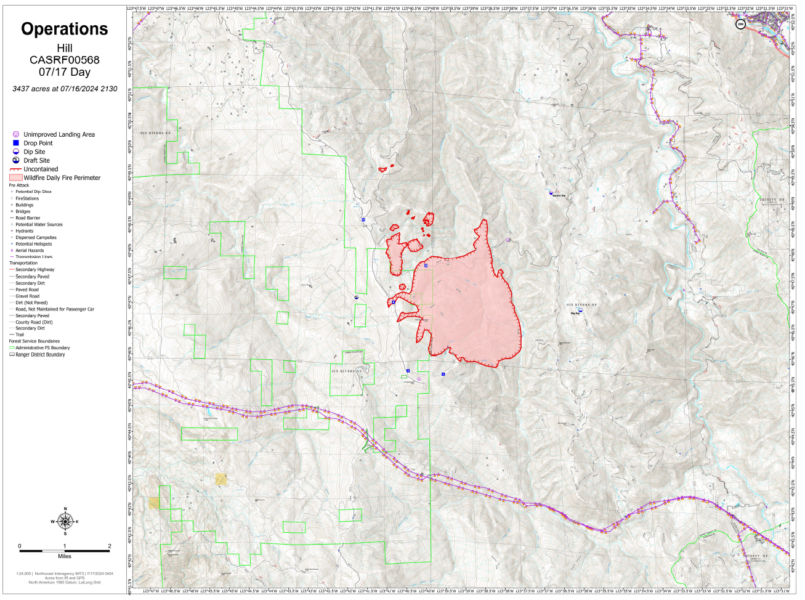
- Operations Map –to see details either zoom or click on the map and download a pdf.
Evacuation Information:
- Click here for the latest evacuation information from Humboldt County Sheriff’s Department and Humboldt County OES and the Genasys Map.
- As of last night:
Mandatory Evacuation Orders have been issued for the following zones. Leave now!
-
-
-
- HUM-E077-A
-
-
Evacuation Warnings have been issued for the following zones. Be prepared to leave!
-
-
-
- HUM-E077-B
- HUM-076-A
-
-
Here’s a screenshot of the map with the evacuation information at this time. Click on the image of the map to be taken to the latest map from Genasys.
Closures & Restrictions:
Closures:
Road closure is in place at Friday Ridge Road at Forest Service Route 6N06. Fire
Restrictions:
Forest fire restrictions currently in effect across the Six Rivers National Forest. Campfires and stove fires are restricted to those developed areas listed in the forest order located at https://www.fs.usda.gov/Internet/FSE_DOCUMENTS/fseprd1188610.pdf.
Smoking, welding, and operating an internal combustion engine also have restrictions in place.
Additional Fire Information:
The Hennessey 2, Ridge 2, and Waterman Fires are all staying within their fire perimeters of less than a quarter acre each. This will be the last update for the Hennessey 2, Ridge 2, and Waterman Fires unless significant activity resumes.
Earlier:
- Lightning Activity Starts Fires in the Shasta-Trinity National Forest
- At Least 50 Lightning Strikes in the Six Rivers National Forest Cause Multiple Fires
- Evacuations as the Hill Fire South of Willow Creek Grows
- [UPDATE 10:11 a.m.: New Evacuation Information] Hill Fire in Humboldt County Jumps to 3,437 Acres, 0% Containment


Join the discussion! For rules visit: https://kymkemp.com/commenting-rules
Comments system how-to: https://wpdiscuz.com/community/postid/10599/
I’d avoid using links from the hotshot wake up. He’s a pretty controversial influencer within the fire community.
Agreed. Obviously this is only a video that someone else shot, but Hotshot Wakeup is not a credible source.
Was up there this afternoon (Wed 7/17).
—
Main fire had ‘laid down’ (low active), crews were starting backfires along FH1 at Spike Buck Flat. (Just off Titlow Hill Road).
—
Lots of dozers up there… they had renewed and expanded the fire line the west side of FH1. 2 years old… now fresh dirt.
There were some spot fires down in the timber… dealing with those might be a problem.
Hopefully they have the fire controlled.
—
Previously they had ‘fire retardant bombed’ the communications station.
Turned it pink !
I like it in pink. I don’t think it would look good in burnt black.
Yeah, melted isn’t a good look for communications equipment. I remember watching a later video of a Carr Fire tower camera that operated right up to the moment everything failed. Like looking into a furnace.
Thanks for the update BOZO…
Yeah I screwed up… should have taken some photos of the back-firing !
They were only about 70 feet off of the roadway. Pretty dynamic stuff.
RHBB would have liked it !
The pink retardant is really bad for the environment and watershed including wildlife habit. There was talk it was being removed from this type of use. Any information on the topic? TIA ?
This…???
( It’s important to distinguish between the “fire” retardant used in aerial drops, and the “flame”retardant used in residential furniture, etc…
They are both toxic to different degrees, but they are very different in the way they are implemented and regulated…)
https://aerialfiremag.com/2023/07/03/the-drop-banning-retardant-will-cost-lives/
https://www.pbs.org/newshour/nation/judge-says-fire-retardant-drops-are-polluting-streams-but-allows-use-to-continue
Effects of breathing
…
What happens if you breathe in fire retardant
Flame retardants have been linked to neurological damage, hormone disruption, and cancer. A significant concern is the bioaccumulation of certain flame retardants in humans, leading to persistent, chronic health issues as levels of these toxic substances increase within the body over time.
https://www.saferstates.org
Toxic Flame Retardants – Safer States
This post importantly concerns flame retardants used in residential upholstered furniture, etc., but it doesn’t specifically address issues with aerial fire retardant drops, which are very different, but still a very real concern…
https://www.niehs.nih.gov/health/topics/agents/flame_retardants
…”What is known about different types of flame retardants?
The hundreds of different flame retardants are often grouped according to chemical structure and properties. In general, such groups may be based on whether the flame retardant contains bromine, chlorine, phosphorus, nitrogen, metals, or boron. A few types are described here.
Brominated flame retardants (BFRs) contain bromine and are used in many electronics, furniture, and building materials. BFRs have been linked to endocrine disruption and thyroid disfunction. Older compounds have been replaced by new versions that also show toxic endocrine effects.
Hexabromocyclododecane (HBCD) is a brominated flame-retardant additive used primarily in polystyrene foam building materials. HBCD enters the environment during its production and by leaching from consumer products. It has been found to enter the food supply. Health concerns include alterations in immune and reproductive systems, neurotoxic effects, and endocrine disruption.
Organophosphate flame retardants (OPFRs) are widely used in textiles, electronics, and industrial materials and as replacements for other types of flame retardants. Studies suggest these chemicals could pose a risk to bone and brain health.
Polybrominated diphenyl ethers (PBDEs) do not chemically bind with the products to which they are added, such as furniture, and are easily released into air and dust. Production was phased out beginning in 2004. Despite phaseout, this compound is stabile in the environment and products containing PBDEs remain in use, suggesting exposure will continue for some time. A major effort has been devoted to evaluating potential health risks. Evidence links human exposure to neurodevelopmental disorders.
Tetrabromobisphenol A (TBBPA) is used in plastic paints, synthetic textiles, and electronic devices, and as an additive in other flame retardants. This compound was found to cause cancer in rats and mice.”
https://rdrtechnologies.com/blog/fire-retardant-dropped-planes
‘What Is Fire Retardant Made From?’
“Fire retardant is a mix of chemicals designed to help extinguish or slow the spread of wildfires. The exact ingredients can vary depending on the fire’s fuel, as different chemicals are needed to combat other fuels.
Generally speaking, fire retardants may contain the following fire retardant ingredients.
Water
Ammonium sulfate: a fertilizer used to reduce the fuel for fires.
Potassium silicate: a mineral salt that reduces the combustibility of fuels
Borates: they serve as a wetting agent
Lignosulfonates are a byproduct of wood pulp production and act as an additional wetting agent.
Gelling agents: help to adhere the fire retardant onto the fuel, allowing it to stick longer.
Other additives may also be included depending on the fire, such as an anti-foaming agent to prevent it from developing suds on the surface and an organic dye for easy tracking of its deployment.”
Different things. Air tankers are dropping a mix of borate in water, with red dye. There are other chemical treatments that were used in clothing and furniture. Two way different issues.