
Odd, Old News: Who Were the Romani?
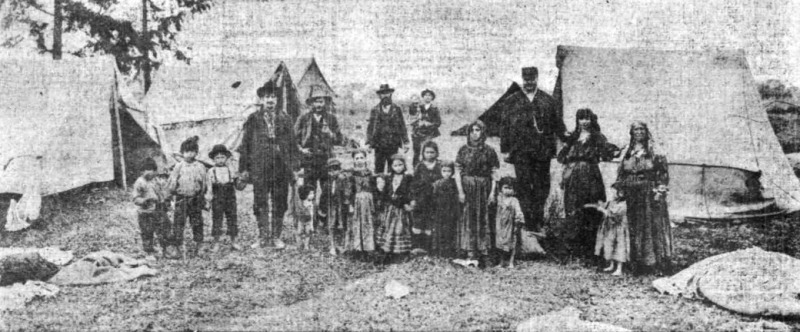
Portland Roma Camp 1905. [Photo from Wikipedia]
WHO WERE THE ROMANY?
Wikipedia tells us “The Romani people (/ˈroʊməni, ˈrɒ-/), also known as the Roma, are an Indo-Aryan people group, traditionally nomadic itinerants living mostly in Europe, as well as diaspora populations in the Americas. The Romani people are widely known in English by the exonym Gypsies (or Gipsies), which is considered by many Romani people to be pejorative due to its connotations of illegality and irregularity as well as its historical use as a racial slur.”
There are approximately one million Romani living in the United States, and 800,000 in Brazil. Some of the Brazilian Romani were forced out of Portugal during the Portuguese Inquisition, but much of the emigration to the Americas from Europe occurred in the late 19th century.
Being a member of a minority ethnic group in Humboldt County meant one was subjected to close scrutiny and an increased likelihood of making the news. The different Romani groups who passed through Humboldt County were met with fear, some earned, much projected, as fear has a way of doing. Local’s attitudes ran from terror and intolerance to bemusement. The widely held view of their being shiftless scamming vagabonds was often perpetuated in the press, and sometimes by their deeds. In 1897, the behavior of a group of Brazilian Romani traveled through the towns around Humboldt Bay seemed to reinforce the ethnic stereotype. But first, this week, Odd Old News will share some different newspaper accounts of the Romani and their culture that run counter to popularly held views. Note some contradictions in the information presented, the Romani have long cloaked themselves in mystery.
RICH GYPSIES
I have no doubt that half million of the million and a half gypsies we now have among us are what are known among the Romany as drom gypsies—that is gypsies of the road; gypsies whose heritage of patriarchical and pilgriming tradition will no more permit them to herd in towns, save out of necessity, than will foxes. Of these, as I have previously stated in print, I have names and addresses of nearly 1,000 heads of families, or petty tribes, whose combined wealth exceeds $200,000,000. Hosts aside from these have gained or are securing little properties. These largely consist of fine farms, country tavern stands, toll-gate privileges, tracts of woodland of which they are very fond, livery and sales stables in the smaller towns and villages, and, not infrequently, extensive town properties, particularly the larger sale stables in metropolitan cities. Thousands upon thousands are able to live comfortably without effort upon rentals and other incomes. But they are never idle, and they never fail of passing some portion of each summer upon the road. Their tradings or preparations for trading, never cease; nor does their fortune telling, for the wife of a gypsie is worth $250,000 —and I have the acquaintance of more than one of these—will as nimbly tell your fortune for silver as would the wife of the most poverty-stricken gypsy tinker I ever helped solder a pan or patch a kettle. — St. Louis Globe-Democrat”(Blue Lake Advocate, 5/15/1888)
Although the American press was full of accounts of gypsy queens, according to one source there were no such queens:
That creature around whom has been woven such exaggerations of romance—the gypsy queen—is but another creation of the imagination…The prevalent idea held by outsiders that any among them is entitled to royal prerogative is a matter with them for ridicule and laughter. Prominent among Romany characteristics is the desire to mislead those not of their race in regard to their methods of existence. They possess a keen enjoyment in the absurdities of others, particularly if these absurdities are errors about themselves.– Chicago Herald. )

Image from the Humboldt Times, 5/12/1899
Queen Stella would have disagreed. When her tribe’s seeress foresaw the demise of Spain and its empire, Queen Stella of the Gamalez gypsies of Granada Spain came to America, and toured the East Coast looking for a place for her people to relocate. In an interview with the press, she shared the matriarchal nature of their tribes, and some cultural differences:
There are about 415,000 gypsies in Spain, who are amenable to no laws except those of nature. The tribes are ruled by women and believe in their inspiration and authority. ‘What I think my people think; what I say they believe implicitly,’ says Queen Stella. “We are an indolent race. We keep our strength. You Americans do not. You live so furiously, but we just live day by day and all we want is happiness. Everything comes to us according to destiny. Your politics bring you trouble that we know nothing about, and what does it all mean? Why, only, ‘You get down, I want to get up’”. (Humboldt Times, 5/12/1899)
Another account shared a more honorable side of the Romany that contradicted the dominant stereotype:
It may be strange information for those who regard gypsies as outlaws that no people living are more are more regardful than they of the law and rights of others. But that is true. Go where you will along the quiet countrysides of our land, where, as the sunny days of the year, they bring these welcomed cavalcades among the farm and village folk for the annual dickering and duckerings, and you will find that no gypsy family or band pitches its tents, builds its fires and puts its beasts to tether without an actual legal bargained right to do so. Sometimes the price is paid in money, sometimes in tinkering, sometimes in the dicker of horse or mule, and sometimes even in free fortune telling for the farmer’s family. But it is always paid. From the Pemaquan of Maine across the continent to Los Angeles, and everywhere north and south where farm homes are in all that mighty distance, the gypsy camp fires are annually relighted above the ashes of the last year’s cheer on this clean cut, canny plan.—Edgar L. Wakeman in Courier-Journal. (Humboldt Times, 8/12/1887)
The early visits of the Romany to Humboldt County seemed to be more tame than later on. In 1881, a “Gypsy fortune teller” arrived with one group who appeared in the Humboldt Bay area. The desire to know what is to happen is as old as human nature, Romani fortune telling was a popular and lucrative enterprise.
GYPSIES
The Gypsies. —We have in our midst a band of real, simon-pure gypsies, late from England, bent on their profession, fortune telling. We are in the habit of laughing at the idea of being told what is to be, or even what has been, in our lives; but there is, nevertheless, an inborn curiosity that prompts most of us to seek just that information which we believe cannot be given us. A small part of this band was here a month ago, and the money they carried away tells better than we can the amount of credulity that is hidden away in human nature. The band is located on the Duff property, opposite the brewery, and business is already reported as brisk. On Sunday a fee of 25 cents will be charged at the gate, but this is no part of the charge for “a fortune.” Madame Standly informs us that her prices range from $2.50 to $l5. (Humboldt Times, 3/10/1881)
Their stay in 1881 was brief:
Our gypsies, including the men, women and children, departed on the Los Angeles. We are inclined to believe that their visit was not a financial success. Whether this is due to hard times or good sense, we leave our readers to conjecture. (Humboldt Times, 3/23/1881)
At least they didn’t leave their animal companions behind, as was the case later a decade later near Marysville:
According to the Marysville Appeal there is a bear roaming the river bottom in the vicinity of Linda that, when it sees a man, rises on its hind legs and begins to dance. It is thought the creature must have escaped from some gypsies who recently passed through the town. Many of the ranchers living near there are so frightened that they sleep in their wind-mills at night. (Blue Lake Advocate, 11/21/1891)
Next week… THE ROMANI INVASION OF 1897
Earlier Odd and Old News:
There are many, but here are the most recent:
- The Wreck of the Steamer ‘Active’ North of Shelter Cove
- Early Adventures in Automotive Travel
- A Trip Up the Coast to Crescent City
- ‘Dope Evil Plainly Growing,’ Warns Early Eureka Newspaper
- A Real Fight With a Bear Up Mad River
- A Carriage Ride Down the Coast in 1892
- Lively Times At Klondike
- Drinking And Gambling Didn’t Mix
- The Round Valley Coal Fields
- ‘The Gypsies Are Coming!’


Join the discussion! For rules visit: https://kymkemp.com/commenting-rules
Comments system how-to: https://wpdiscuz.com/community/postid/10599/
Canadian author, Farley Mowatt (Never Cry Wolf), wrote a book based on the notion that “Gypsies” or Romani, were the early,”indigenous” people of Europe, or at least predated some major migrations that pushed them North. Mowatt’s claim then was that the Picts of England were of Romany descent. He further postulated that they were pressured to keep moving to the Faroes, Iceland, Greenland and North America, several hundred years prior to the Norse migrations. Mowatt thought that the early immigrants were assimilated into local tribes. There were great social upheavals and changes in Tribal territories in NA prior to Erik the Red, and crew showing up. There are many archaeological sites from Iqaluit, down to Labrador, and NovaScotia that seem to indicate a boat landing, and tipped over to shelter over winter. Many mainstream archaeologists ridiculed Mowatt, as he was just an “amateur”. This was all 25 years ago. I haven’t followed up on more recent notions.
Full disclosure: I met Farley Mowatt on a Russian boat cruising to check out some spots. (It was hard to keep up drinking with that guy!)I was smoking a Doobie on shore in a remote bay when a huge iceberg rolled over!
Yes, if you read Farley Mowatt’s book The Siberians, you learn the quickest way to Farley’s “trans-polar proletarian” heart is liberal use of alcohol.
I have discovered that alcohol makes people much smarter…
However, actually the diasporation ( I hate people that use big words, diasporation theory means a group of people moved to a new place) The theory of Farley Mowat makes perfect sense, and the more we find out about America’s early history the more that it does make sense.
When my mother was but a wee lass she remembers Gypsies coming through Laytonville. They were tolerated but not trusted, and were expected to move on as soon as possible. That treatment was not only for Gypsies, but anyone that was not in the valley for a good reason. If you showed up in Laytonville you had better have a good reason to be there. Like visiting family, looking for a job or any other legitimate reason. Then, like fish after three days they were thrown out.
Just like today there were gullible people that were dumb enough to try to sample the Gypsie’s wares. People would buy their snake oil, have their palms read and their fortunes told, play card games etc. While all this was going on the young Gypsie kids were stealing chicken, eggs, vegetables out of the gardens, and clothes off the lines.
They were only in town long enough to case the place and ply their trade, and were gone in the middle of the night to cover their tracks. (Moms story, not mine)
Nowadays, the Gypsies are on television, they sell these little pills that they have miraculously manufactured. They use a complicated process that only they know how to do. They chop up a whole vegetable garden and a whole fruit orchard and pack it into this little pill. This pill will solve all your problems, no doubt about it. You will feel young again, stronger, smarter, faster. Then there is this little hint that women won’t be able to resist you. I’m not sure what it does for women, they don’t say. Maybe it makes them smart enough to hide.
I tried these pills and I will give them Five Stars. I took one and figured out that it didn’t do a darn thing for me. But, it did make me smarter, I, at least figured out that they don’t do all of what they say. So now instead of chasing the Gypsies out of town, I mute the TV…. Take that.
Fridays are my busy days. Last week David’s Odd News had spun off the page before I could comment. I wouldn’t want him to think that I’m boycotting him. I like his stories too much for that.
The entire article is an ignorant take on the Roma. Shocking no one wants to talk about it ?
We are listening
Actually, it is human nature to not trust strangers. The first thing that we teach our kids is “Do Not Trust Strangers”. Nobody argues with that.
The Roma moved around and didn’t stay in one place very long. By their very essence, they were strangers. Human Nature tells us to be wary.
Just look at the blogsites. How many of us trust anything that “Anonymous” posts. People trying to hide their evil side are certainly not going to tell you who they are.
Throughout history there are stories as to why we don’t trust strangers. Look what happened to the people of Troy when they trusted those Greeks that showed up at the gates of troy and left them a present.
The Greeks and Troy were in a great war and Troy was kicking butt. The Greeks figured that the only way that they could win the war was to breach the gates of troy. So, the Greek architect, Epeius, designed a big wooden horse and they hid their version of Seal Team-6 inside. Then they left the horse at the gates of Troy. The people of Troy thought that it was a gift to try to appease them.
greece.mrdonn.org › trojanwar
“The people of Troy rushed outside, cheering their victory! They dragged the heavy horse inside the city gates and put it on display, which is just what the Greek general thought they would do – gloat. That night, while the Trojan people were sleeping, the men hiding inside the wooden horse climbed out and opened the gates.”
The moral of the story is “never trust a stranger.” The story is oft repeated as, “Never trust a Greek bearing gifts”. On the surface it sounds racist, but if you know history, it a great compliment of the Greek people that won the battle with their ingenuity.
The more accurate the history that you know the wiser that you are. Whether the history is good bad or ugly. Be wise, know history correctly, don’t censor or change it.
Eileen— feel free to share your criticisms. I was hesitant to attempt to describe another ethnicity, particularly after going through about 70 news articles from that time period, most of which were dramatic portrayals of their worst behavior. So I looked for other articles from the era that reflected ‘non-crime’ reports and used those to attempt to counter the stereotyping of the Romani, seeing them only through the crime reports. I didn’t try to capture their whole culture which is unique and remarkable, nor would I try. Also, to portray a few million people’s culture and lives through the behavior of a minority of them would be disingenuous, and I tried to avoid it. I would love it if someone would nuance the seeming both patriarchal and matriarchal nature of the group. There are definitely times when the shallowness of my research has pained me, and I am sorry if this look at the Romani through the lens of papers of the day, or my prelude comments are merely adding to the mis-characterization or stereotyping of a little understood ethnic group. Odd Old News can take severe criticism, so feel free to share your dismay.
Next week we will look at all the incidents that happened when one group came to Northern California.
I am waiting with bayted.. baited.. abated.. bated. I’m waiting breathless.
The article from the Chicago Herald claiming there were no queens was used in the Humboldt Times, 2/7/1889. Again, these are the articles that were chosen by the editors of the Humboldt Times and Blue Lake Advocate for their audiences at a time when the Romani were taking a lot of bad press. Perhaps a better, and less presumptive title would have been “The Romani in the Local Press”.
I wouldn’t worry about the critique, David. History is not woke enough for some people these days, so they automatically throw out blanket criticisms with no specifics. I doubt you’ll receive a long ,intelligent rebuttal.
You probably wouldn’t care for what is happening in the entomological world where to avoid insulting the Romani with an ethnic slur, the name “gypsy” moths has been changed to its Latin name, Lymantria dispar dispar, or LDD(for ease) as part the Entomological Society’s Better Common Names project. I think that the line where awake/be aware ends and woke begins is still getting determined.
I have an appreciation for old news myself, that said your actual statements make me wonder how much do you actually know about us considering you’re flagrant use of a racial slur. I’m Romani and from what I see you know pretty much nothing factual. Wikipedia is a terrible source for empirical information, especially where closed cultures are concerned. For those referring to really rediculous assessment and guesses about us from so called “thinkers”, your wrong. We came from India and are NOT indigenous to Europe we’ve been refugees for more than 1500 years. Please stop using the racial slur gypsy we are a DNA verifiable race and gypsy is a externally imposed title given by people who’s nations did things like enslave or hunt us for sport like foxes legally. That’s actually how the majority got to Brazil by the way it as you said but as slaves.
Thank you Anya, I failed to do a good job, and attempted to acknowledge that in my several comments…I admitted that this was not an attempt to portray their real culture and shared more in a later post of the history of their suffering ruthless cruelty at the hands of European “Christian” countries in a linked article. In the end, the presumptious Who Were the Romani title should have been A Newspaper Look at the Romani …. No I don’t know anything about the Romani culture except a little bit that I have read, there is one book out written by a Romani man that got mixed reviews, I may try and find it. I feel that you and Eileen were right in chiding me, I picked a bad week to not have time to do a good job on a sensitive topic, and I apologize to all those who may find this post in an online search because of the title. I have to really look at the glamorized lens that I have looked through all my life, kind of like all the Hollywood actors and actresses who played Romani parts in a slew of early 20th century black and white movie titles. Perhaps we learn most from our failures… I have.
I am not going to explain ignorance to anyone. Elsewhere, these are a legally protected people. Perhaps we’ll catch up at some point in this country ?
That’s the non answer i was expecting.
Boring
Utilizing white peoples’ historical views of a culture they don’t understand, and using brief Wiki quotes to introduce the culture rather than linked quotes from in depth presentations is a real weakness of this cursory presentation as I view it. My thinking for doing a series on the Romany in our area was motivated by a wish to show the ubiquitous ‘stranger-danger’ part of the human psyche in action once again. During an exhausting week, I realized that I needed to do more when addressing a minority ethnic group, and I didn’t really do that. I also realized that I have a huge blind bias where I light up about all things “Gypsy”… the music, the dancing, a culture that has color (and one I project a lot onto)! So, without groveling, I don’t mind criticism, I try to find something in what others say when I can, particularly when I know I haven’t done my best. And I don’t blame you for not wanting to “blargue” by posting more. To the dismay of some, I will say thank you for commenting out of a sense of protecting a minority group from another culture’s widespread ignorance about them.– If I am reading you correctly.
In Italy, back in the Old Country…
My father in law’s family kept talking about the Gypsies, the Gypsies that were living down the road. And he never saw any tents or vagabonds or these so called Gypsies. So he eventually says okay, where are all these Gypsies living that you guys keep talking about ⁉️
Turned out that if your house is built out of wood and not made of stone, they called you a gypsy back then because your house wasn’t permanent! I’m not sure if that’s still the case or not but it was (My father in law is in his 80s ;)…
They are all a bunch of criminals who will steal anything! It’s what they do!
Howard Scott once defined a criminal as …”a person with predatory instincts who has not sufficient capital to form a corporation”.
My mother’s mother’s mother was definitely a gipsie (how she spells it) but would never talk about her family. She and her husband continued on in Oregon with a family and what not. She passed a few things on to the women in my family, who passed them on and so forth. I have friends in my life who carry the gipsie spirit. People have always feared new or unknown. Naturally, this way of life would make you an untrusted outcast by default. Just as it works in small towns today. The wisdom passed on to me, and I will pass on to my daughter, has not a dang thing to do with stealing or snake oils or how to pull the wool over someone’s eyes… It’s about hard work and making your own way. Nature and the energy you share with it. It’s about my place on this earth and worrying only about that… And how. It’s about family and knowing what you are a part of. I swear, it’s like the mystery of the Witch. Same difference. Some people feel it is unnatural to stay in one permanent spot. So they stubbornly choose not to conform, no matter how hard you try and make things for them. Because out on the road… You’re truly a free spirit. And your spirit is EVERYTHING. Conforming is death. Death before conforming!
I really enjoyed reading this article!! Thank you so much for the fun stories. I will be watching for the next one. Cheers!
Nice to have an inside view, thanks for sharing.