
B.A. Program for Pelican Bay State Prison Is First of its Kind in California
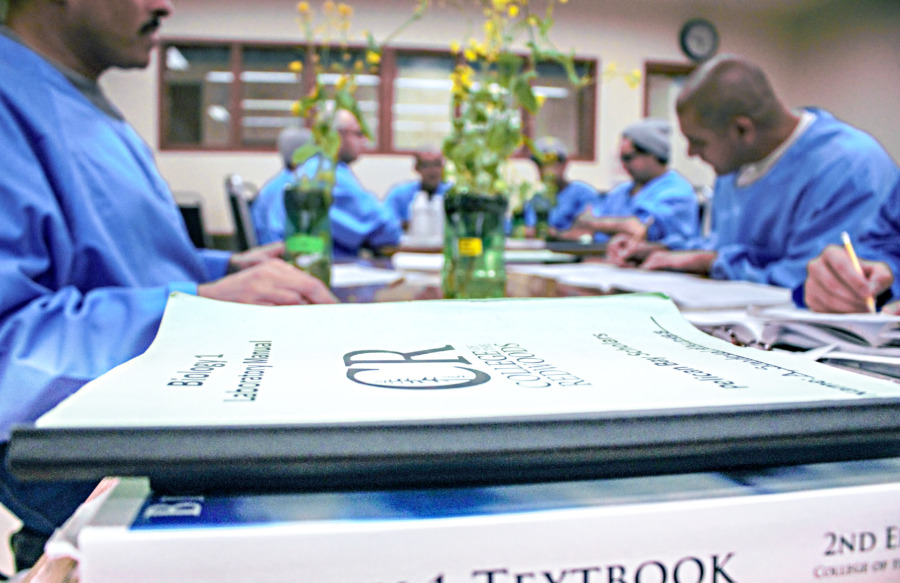
Incarcerated students in College of the Redwoods’ Pelican Bay Scholars program, which has partnered with Cal Poly Humboldt and the California Department of Correction and Rehabilitation to create the B.A. pathway program.
Press release from Cal Poly:
Incarcerated scholars at Pelican Bay State Prison will soon have the opportunity to earn a B.A. in Communication from Cal Poly Humboldt.
It’s the first B.A. program to be taught in person on a Level IV yard (a high-security facility) in California. The program is a partnership between the University, College of the Redwoods, and the California Department of Corrections and Rehabilitation (CDCR).
“CDCR is proud to partner with Cal Poly Humboldt to greatly expand degree-earning opportunities for incarcerated students and further the Department’s commitment in expanding ‘grade school to grad school’ opportunities,” said CDCR Secretary Jeff Macomber. “Collaborative efforts between CDCR and California’s public higher education system are truly transforming lives.”
“This new B.A. program and our partnership with Cal Poly Humboldt exemplify the power of collaboration,” says Keith Flamer, president of College of the Redwoods. “Together, we’re rewriting the narrative of education within the prison system.”
The first cohort starts in 2024 with 20-25 students who’ve completed their associate’s degrees through CR’s Pelican Bay Scholars Program.
“It is exciting to see a bachelor’s degree option coming to the 130 graduates of our CR Pelican Bay Scholars program at Pelican Bay State Prison,” says Rory Johnson, Dean of the Del Norte Education Center & Pelican Bay Scholars Program. “Working with our partners at Cal Poly Humboldt on this joint initiative has been a pleasure. CR has gained valuable experience in establishing a successful college program in a maximum security prison and we’re happy to collaborate with Cal Poly Humboldt to share our insights from the past eight or nine years to help them avoid reinventing the wheel.”
The program increases access to education while providing students a greater chance of success once released.
“At Cal Poly Humboldt we define ourselves by who we include and not who we exclude,” says Jenn Capps, provost and vice president of Academic Affairs at Cal Poly Humboldt. “Creating access to education is one of our primary goals and launching the bachelor’s degree at Pelican Bay, the first bachelor’s degree in a Level IV yard in California, does just that—creates access to education and improves outcomes for people who are incarcerated and the communities they return to.”
The program will offer two, then four courses per semester as it scales up. Classes have the same curriculum and resources as those offered on campus. The first cohort is expected to graduate in Spring 2028 with a commencement ceremony in the prison.
Incarcerated students now also have access to federal financial aid to help with tuition costs. For the first time since 1994, the students are now eligible for Pell Grants under the FAFSA Simplification Act. Access to these grants was restored as of July 2023. .
Research shows that access to education reduces recidivism.
“Education is one of the greatest rehabilitative programs we can offer,” says Tony Wallin-Sato (Journalism, ‘20), program director of the the Humboldt Project Rebound chapter. Project Rebound helps currently and formerly incarcerated individuals enroll in and graduate from California State Universities.
Wallin-Sato is working with the University’s new Transformative & Restorative Education Center (TREC) to jump-start the B.A. program.
“Ninety-five percent of incarcerated individuals are going to come home, and we should create the greatest possible reentry plan for them for success,” Wallin-Sato says. “If a four-year degree from a public university in California costs approximately $32,000, and a single year in prison in California on average costs $100,000, then economically we are throwing away money instead of working towards compassionate-centered work.”
Research from RAND Corporation shows that “every dollar invested in correctional education saves nearly five in reincarceration costs over three years.” Additionally, RAND found, formerly incarcerated people are 43% less likely to reoffend and more likely to be employed when they participate in any type of education program.
Project Rebound is a testament to that. “We have less than a 1% recidivism rate for students who finish their degree with us,” says Wallin-Sato. “Education is medicine for recidivism.”
He helped launch Humboldt’s Project Rebound chapter in 2020. As its director, he provides support for students adjusting to life outside of prison—students with whom he shares a common experience.
When Wallin-Sato arrived in Humboldt from Sacramento to pursue his degree after his own struggle with incarceration and addiction, it felt isolating.
“Being formerly incarcerated with a tattoo on your face, you kind of have these moments where you doubt yourself being on campus if you’re not with your peers who have shared experiences,” he explains. “So I started the first ever formerly incarcerated students club at Humboldt.”
Now he works to extend access to higher education to currently and formerly incarcerated individuals. He’s part of a working group that includes other universities, the CDCR, and Cal Poly Humboldt staff, including Steve Ladwig, director of TREC; Mark Taylor, Project Rebound youth outreach coordinator; and Communication Professor Maxwell Schnurer, that aims to make more B.A. programs available in California prisons.
The Communication degree is advantageous for Pelican Bay scholars because it is offered at other lower security prisons in California. So if a student transfers facilities, they can continue their degree, Wallin-Sato explains. If a currently incarcerated scholar is released before they finish the program, they can continue their studies at Humboldt or elsewhere.
Studying communication prepares graduates for a wide range of career options. The job market for this and similar fields is expected to grow over the next decade, according to the Bureau of Labor Statistics.
Employers desire effective communication, according to research from platforms including Indeed.. Studying it strengthens critical listening, public speaking, and advocacy skills.
Communication is the only B.A. currently offered through the program. In the future, project partners hope to expand degree options.
Wallin-Sato hopes that the program allows its students a greater chance at reintegration so they can make a positive impact on their communities and society as a whole.
“Just because they are incarcerated doesn’t mean they aren’t a part of our community,” he adds. “The majority of people incarcerated need support and resources, not isolation and exile.”


Join the discussion! For rules visit: https://kymkemp.com/commenting-rules
Comments system how-to: https://wpdiscuz.com/community/postid/10599/
Incarceration is hardly a strategy for success in the modern world.
I like the adaptation required to form a “formerly incarcerated” club…
“Knowledge is Good” Emil Faber
You can go to Law School totally on-line, and later, you can start a practice for “formerly incarcerated” folks, Divorce, Family Law, Estate Planning…
Trump may well become the first “Formerly Incarcerated” President, and I think he is the one most likely to be convicted a felony…
they could call it the priors club
This is a nice start, but really society owes these parasites and predators so much more.
It’s got nothing to do with society “owing” convicted criminals anything, it’s got everything to do with society owing it to ourselves to give the best odds that the people who emerge from incarceration back into the general population will find a more productive path than the one that landed them in prison in the first place.
Yes. Because every criminal is prison is there because they lacked the education to get a good job. Not because, unlike the vast majority of people not in prison despite starting from the same exact place, they chose crime. Just what the world needs- better educated prisoners. Who will about take two months to turn their government supplied education communication tools (ie lap tops) into a way to get drugs into prison to sell. And just wait until they get out! Oh the articles that will be written! All employed by various criminal reform lobby groups just like every drug addict in rehab announces they want to become drug counselors when they are through. Indeed, saying it is about society owing it to “themselves” is extortion- “give me what I want or I will make you pay.”
Project Rebound, which “recognizes that Humboldt is on Wiyot land” and “connects students to free legal services through our community partners whose expertise includes record reduction, reclassification, and expungement, and employment discrimination.” Like “President for the Formerly Incarcerated Student’s Club” or “Upon release after my last incarceration and after a lifetime battling substance use disorder, I made a decision to go back to school. It has been the best decision I have ever made, for my present and my future” or “Prison Ecology and Food Justice ” or “Experienced Incarceration.” It’s a window into the exact difference that lead to there is never a mention of gratitude for being given the opportunity to give back to the society they damaged or that is for providing them now. Theirs is the song of Me,Me,Me.
https://projectrebound.humboldt.edu/pr-home
I feel like your reading comprehension has gone down recently. No one said anything about how people ended up in pelican bay.
We know what happens when we lock people down for years and then release them back into society, they continue making the kinds of choices that led them to prison to begin with and will lead them back again. And we, as a society, pay financial and cultural costs for that system.
If we are going to spend this money on incarceration of people who will be released back into society then we owe it to ourselves to use some of that money to create conditions where the person released is more likely to become a contributing member rather than a burden. It’s pretty simple economics and social self interest.
I liked this video, and it applies to convicts as well…
https://www.youtube.com/watch?v=yRWmKh13b50
What’s really simple is they’re convicted criminals in prison as punishment for one or more crimes….not to get an education on my dime.
Their getting an education on our dime either way. Prison isn’t free for taxpayers and this type of program doesn’t change the cost much at all.
The choice is whether we choose to have our money go toward an education that will make it more likely they find a new path when they are released or have our money go toward an “education” in criminality that ensures they continue to make choices that harm society.
I don’t need a college degree to see which of those I’d rather my money go toward.
Which is the point prisoner advocates seem to always miss. What they are or were in prison for doing. That’s not of interest to ex prisoners or their advocates but always is for those who were victims. And may be again.
Besides It’s more likely recidivism is mostly decreased by the aging of the incarcerated rather than education.
Then they can get a job and earn their way to a degree.
No, they can’t. Who is going to hire an uneducated former felon?
The lck of setting people up to successfully re-enter society is part of the reason we have such high rates of recidivism.
I agree with your excellent comment 100%. It is not a handout, but and hand to help get up. Only the ones that really want to turn their life around will be taking classes.
The California Department of Corrections and Rehabilitation typically does neither so this program is a step in the right direction.
Credit to the prisoners, er, I mean “currently incarcerated persons” who are participating. Hopefully when they get out (and 95% do get out according to the story) they’ll be able to maintain their status as “formerly incarcerated persons” and not go back.
What housing shortage…they must have some open cells up there in Del Norte…can’t be much worse than the “Danco Dorms” in Valley West!
“Experienceing Incarceration.” Like a meteor fell from the sky, it just happens.
That is some punishment!
The goal is supposed to be correction and rehabilitation.
This sounds like a good step in that direction.
Whatever did the man do on the Rebound website who “earned six associate degrees while he was serving a life sentence in the California Department of Corrections and Rehabilitation (CDCR)?” Well redemption is good but it would be nice to express some gratitude for opportunities provided to people who already bit the hand that fed them just so those not so provided with those opportunities have a chance to feel good about it too. Like one of those degrees being used to prevent others from biting in the first place rather than being all about helping reformed biters live a better life. Given the nature of the people involved, it’s likely too much to expect such respect for people they don’t identify with. Arrogance and self involvement is a mark of criminal choice but even those people deserve some tolerance. Even if grudgingly.
The old testament puritanism at the root of our national identity always comes out in prison stories. We want punishment! Retribution! Revenge!
Screw the long term social costs, as long as the bad ones are made to suffer.
Oh pity me! The victims of prison… if criminals got the same amount of attention that some the poor joe who worked steadily for 40 years, supported his kids, did his civic duties without even one arrest got half the attention and government support and advocacy that a criminal who killed someone and went to prison for decades does, they would be shocked.
The religious text that covers criminals is actually Luke 15:17–20. Few demand retribution. But they do demand acknowledge and amendment first. Sorry that makes you angry. But as was said in John 8:11, it comes with acknowledgement and, since the sin in both verses is the insistence of their selfish wants even if it harms others, ythe first step is to acknowledgethe sin. Damned Puritans with their bible virtues. How dare they believe in redemption.
This program must have something to do with the reason CAL State I raising tuition. Can’t be cheap to have traveling professors.
Either that or CDCR feels that their debt to society should also include student debt.
Student debt.. now there’s a life sentence!
What I’m curious about, is since these academia types that have never built, innovated or marketed a damned thing, and are teaching “diversity, equity and inclooosion”… inherently Marxist principles, but they expect capitalist compensation.
Oh boy, and these Sacramento parasites see this as an accomplishment. You know which system has the lowest recidivism rate for hard-core criminals? Japan’s, and here’s why:
First 30 days of good behavior, you get a blanket.
Six months of good behavior you get a mattress.
One year of good behavior you get a heated cell.
Two years of good behavior and you’re allowed to converse with other humans.
This policy is reserved for the worst of the worst, which is exactly what resides at Pelican Island.
Guess what? NOBODY wants to come back. Get it?
My children can’t afford college but convicted criminals can ????? I cannot tell you how truly angry this makes me !!
This could be part of the plan newsom has to turn San Quentin into a country club.
Seems odd that child molesters/murderers could be rehabbed into being school teachers with no public comment about it.
Seems like the money could be much better spent on plain and simple self guided programs for highly gifted children and help with tuition for highly gifted adults. I doubt there’s very much for them here.
wish i could have gotten my bachelors without having to work some bullshit job and had a place to study. back asswards if our society had more options to start with students could be studious and focus on making society better for everyone. education is vital to all
well….just look on the bright side- This will make your BA less valuable