
Cyanobacteria Confirmed in Local Rivers
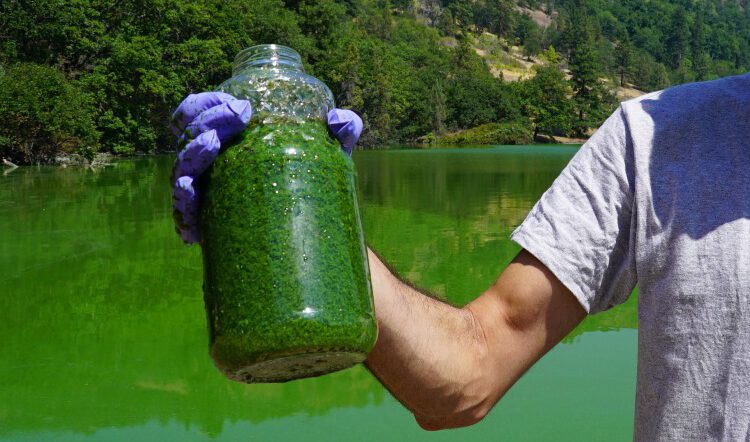
Stock photo of a jar full of Microcystis cyanobacteria in the Copco Reservoir on the Klamath River in a previous year. The algae produces a carcinogenic liver toxin called microcystin, which is harmful to humans and animals, including salmon. [Image from Stormy Staats]
…[L]ocal Environmental and Public Health officials are reminding residents to keep an eye out for cyanobacteria while recreating at area rivers and lakes. This reminder comes after algal blooms were recently detected by North Coast Regional Water Quality Control Board staff in the South Fork of the Eel River at Richardson’s Grove, Cook’s Valley and in Miranda.
Cyanobacteria, also known as blue-green algae, can be present in any fresh water body, and looks like dark green, blue-green, black, orange or brown scum, foam or mats on the riverbed or floating on the water. Cyanobacteria can produce harmful compounds, such as toxins and taste and odor compounds, that cause health risks to humans and animals. Warm water and abundant nutrients can cause cyanobacteria to grow more rapidly than usual causing “blooms.” These blooms are termed “harmful algal blooms.”
In previous years, cyanobacteria has been confirmed in water bodies within Humboldt and surrounding counties, including the Mad River, South Fork Eel River, Van Duzen River, Trinity River, Big Lagoon, Stone Lagoon, Clear Lake and Lake Pillsbury. It is difficult to test and monitor the many lakes and miles of our local rivers. Most blooms in California contain harmless green algae, but it is important to stay safe and avoid contact.
While most cyanobacteria do not affect animals or people, some are capable of producing toxins that can be harmful to animals and humans. Dogs and children are most likely to be affected because of their smaller body size and tendency to stay in the water for longer periods of time.
Officials recommend the following guidelines for recreational users of freshwater areas:
- Keep children, pets and livestock from swimming in or drinking water containing algal scums or mats.
- Adults should also avoid wading and swimming in water containing algal blooms. Try not to swallow or inhale water spray in an algal bloom area.
- If no algal scums or mats are visible, you should still carefully watch young children and warn them not to swallow any water.
- Fish should be consumed only after removing the guts and liver and rinsing fillets in tap water.
- Never drink, cook with or wash dishes with water from rivers, streams or lakes.
- Get medical attention immediately if you think that you, your pet or livestock might have been poisoned by cyanobacteria toxins. Be sure to tell the doctor or veterinarian about possible contact with cyanobacteria or algal blooms.
- Join or support one of the many watershed and river organizations.
To learn more about cyanobacteria and harmful algal blooms, visit the state of California’s website at www.mywaterquality.ca.gov/habs/index.html.
To report a bloom, e-mail [email protected] or call 844-729-6466 (toll free). Blooms can also be reported via the “bloomWatch” app which is available for free download on iTunes or Google play.
For information on conditions in Humboldt County, contact the Humboldt County Department of Health & Human Services, Division of Environmental Health at 707-445-6215 or 800-963-9241. Photos of suspected blooms can also be emailed to [email protected].


Join the discussion! For rules visit: https://kymkemp.com/commenting-rules
Comments system how-to: https://wpdiscuz.com/community/postid/10599/
Please folks if you are headed to a body of water that has the harmful algal blooms keep your children, pets and yourself out of the water. There is always a possibility if you have inhaled enough, it can kill you or your pet(s). To learn more please read the California website covering the blooms, at http://www.mywaterquality.ca.gov/habs/index.html.
What kind of math do fish not like?
ALGAE-bra
On a side note: This reminder comes after algal? blooms.
Sorry, did not realize algal is a correct term.
No need to test – it’s safe to assume that concentrations of algae contain toxins and act accordingly. In any case who would let their kids or dogs play in algae scum infested waters? Another case where the ever less evident – common sense – would be useful.