
The Eel River Forum Took a Detailed Look at Pikeminnow at Their March Meeting
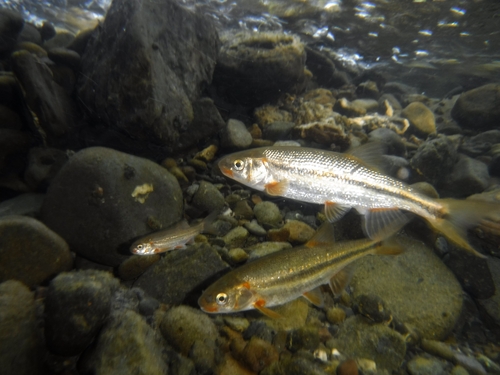
Young Pikeminnow [Photo from Eel River Recovery Project]
Pacific Coast Federation of Fishermen’s Associations considers Pikeminnow to be the most significant obstacle to salmon recovery in the Eel River. Reducing mature Pikeminnow population by 10-20% may decrease the salmonid kill rate by half. Yet in the 40 years since Pikeminnow entered the Eel River watershed, no one has found a reliable method to remove them.
To address the Pikeminnow conundrum, CalTrout’s Eel River Forum held a day long seminar on Pikeminnow science March 27th at Fortuna’s River Lodge Conference Center. Nine Pikeminnow experts presented the information they know, and the studies they are developing to learn more, to a packed room of river biologists and restorationists over a 4 hour period.
While Pikeminnow have been in the Eel River since the 1970’s, Josh Fuller, the NMFS Lead Biologist regulating the environmental impacts of the Potter Valley Project, said NMFS is still trying to develop an effective Adaptive Management Plan and, “I am just so excited that CalTrout is putting this on. We need help right now tackling this issue both in the [Potter Valley] Project Area and throughout the watershed.”
Pikeminnow are an invasive, predatory fish species in the Eel River, but Pikeminnow are native to other salmon bearing rivers of California such as the Sacramento and Russian Rivers. They are incredibly smart in the fish world. Several speakers at the forum report that they have tracked them sneaking out of deep pools where they are protected, to feed in the shallow areas only at night. They also appear to have the ability to learn to recognize fishing lures and to move away from them.
Urban legend says that Pikeminnow came directly up the Potter Valley Project diversion from the Russian River into Lake Pillsbury, but that isn’t accurate. Dr. Brett Harvey of the U.S. Forest Service’s Redwood Sciences Laboratory said this line of Pikeminnow came from Clear Lake and that ten individual fish were likely brought into Lake Pillsbury by one angler.
Pikeminnow were first seen in the Eel River watershed in 1979 and, from those ten fish, were pervasive throughout the watershed by 1986. The only fork of the Eel River not completely overwhelmed by them is the North Fork and BLM Biologist Zane Ruddy told the room that the Pikeminnow may be colonizing there right now. He said there are currently at least three year-classes of Pikeminnow present in the North Fork. Ruddy said, “I hope to instill a sense of urgency in the crowd….now is the time to strike because they are in low abundance.”

[Graph from:Nakamoto, R. J. and B. C. Harvey. 2003. Spatial, seasonal, and size-dependent variation in the diet of Sacramento pikeminnow in the Eel River, northwestern California. California Fish and Game 89(1): 30-45]
The graph above reflects the fact that Pikeminnow eat a wide variety of species and that their diet turns to a larger and larger percentage of fish as they increase in size.
However, even as very tiny fish, they are a threat to salmonids both by predation and competition. Pikeminnow eat such a wide variety of food types that it is suspected that the smallest fish will prey upon the redds before they hatch. Furthermore, smaller Pikeminnow compete with juvenile salmonids for their food sources before they grow large enough to consume the salmonids directly.
Studies show Pikeminnow’s advantage gains when the temperatures rise. Describing a study evaluating the impacts on competition, Dr. Harvey said, “At about 17 C the Pikeminnow are invisible to the Steelhead, …but when you jack up the temperature about 4 or 5 degrees C, then its a different game and the Pikeminnow are a direct competitor to the Steelhead. In fact, it was kind of an ‘adding insult to injury’ situation because the performance of the Pikeminnow in this setting was kind of like that goofy person who won’t receive social cues. …The Steelhead were busy trying to defend their territory as they do; trying to be rude to their neighbors as they always are, and the pikeminnow were [oblivious].” He went on to say that at that temperature adding a Pikeminnow had the same level of competition as adding more Steelhead. They were in direct competition for food.
Another study reveals that in winter, it appears the Pikeminnow retreat from the headlands and return to them later in wetter years and ealier in drought years according to Philip Georgakakos a Dorctoral student from UC Berkeley. Georgakakos said he finds June is the month with the largest difference between wet and dry years in terms of the respite salmonids receive from Pikeminnow predation and competition in the headwaters of the South Fork at his study area in the Angelo Reserve west of Laytonville.
Although there has been little progress in controlling Pikeminnow over the 40 years since their arrival, solutions are being pursued. In the majority of the watershed, Pat Higgins of the Eel River Recovery Project hypothesizes that River Otters are the primary predator keeping the Pikeminnow population from exploding and completely decimating the salmonids. And around Lake Pillsbury where the habitat allows Pikeminnow to thrive, the community holds an annual sport reward Pikeminnow Derby. In the derby, every entrant over 12 year of age, pays an entry fee to compete. That forms the prize pool which is parsed out to the anglers who return with the largest fish, the smallest fish and the most fish. According to Higgins, the last derby may have removed 600 pounds of Pikeminnow from Lake Pillsbury.
The derby model is the preferred model in the Columbia River where the Bonneville Power Administration pays out nearly $4 million a year to reward anglers for removing Northern Pikeminnow. A few anglers in that area make their living on that opportunity according to the program’s director Steve Williams. The Northern Pikeminnow is native to the Columbia River, Williams pointed out, so there is no effort to eradicate the species in that watershed.
In the Eel River more solutions are being explored. Abel Brumo of Stillwater Sciences has been working alongside the Wiyot Tribe toward the Tribe’s goal of returning the river they historically named Wiyot to its former state of abundance–which is the meaning of the word Wiyot. Brumo and the Tribe will be working this summer to discern which Pikeminnow removal method is the most cost effective. Brumo says they will be evaluating boat based electrofishing, nighttime dives with nets, and baited fish traps. They will look at which method makes the most sense for both the money and the time it takes to remove the predatory fish.
Meanwhile, Pat Higgins of the Eel River Recovery Project (ERRP) has hopes of cutting the number of female spawners in the upper South Fork of the Eel significantly enough to increase juvenile returns to the ocean significantly. ERRP has applied for a Scientific Collecting Permit from CDFW to gain permission to have trained fish science experts who can easily recognize fish species from a distance work in the deep pools of the South Fork of the Eel River in the refugia area between Rattlesnake summit downstream to French’s Camp. The proposal is for the volunteers to spear the Pikeminnow larger than 10 inches long in the pools. According to Dr. Harvey each female can produce 15,000 eggs in her lifetime. Therefore, Higgins hypothesized that because the females are the largest fish, killing them has a few benefits. Killing them will reduce current predation of the most mature salmonids, and it could reduce future Pikeminnow population by at least half. California Deparment of Fish and Wildlife has expressed a preference for electofishing for the Pikeminnow over spearfishing because if other species are present, they are not killed accidentally. However, Higgins says electrofishing is ineffective in these deep pools where these larger Pikeminnow are hiding during the day. CDFW has 12 weeks to review the application which was recently submitted.
The most experimental proposal came from Dr. Buchheister of HSU’s Fisheries Biology Department who reported to the forum from Arcata by telephone. Buchheister explained the Trojan Y project which is used in fish farming. Buchheister is working on with his colleague Dr. Rafael Cuevas Uribe. The Trojan Y uses genetic modification, however no extraspecies genetic information is added, to cause almost all offspring to be YY male instead of XY male. In fish farming it is widely practiced, according to Dr. Uribe, to keep the farmed fish from expending energy on reproduction. In the case of Pikeminnow it is being considered because it will cause the population of the target species to crash because not enough females will be produced. To date, there has only been one trial for species control on invasive Brown Trout in Idaho. Uribe said that depending on the number of YY males stocked into the watershed, the Pikeminnow might be expected to go extinct within 10 to 20 years after the YY males were introduced.


Join the discussion! For rules visit: https://kymkemp.com/commenting-rules
Comments system how-to: https://wpdiscuz.com/community/postid/10599/
What kind of a reckless idiot puts non-native fish into a body of water?
It is extremely common. Everyday run-of-the mill idiot.
The story I got as a kid from a good source, was that people would bring them from over by Sac. to use as bass bait on Pillsbury. Supposedly someone had a few left over after fishing and turned them loose just to be nice. Like what the socialists want to do with government. Well intentioned but ignorant acts often result in disaster.
The story I always herd was back in the 70s someone bought pikeminnow fingerlings in chinatown and used them for bait in Lake Pillsbury at the end of the day the a$$hole dumped his bucket of squawfish in the lake!
I hear that if you make cat food out of these pikeminnow the cats would love it and the price of really good cat food is expensive so there you go make some money and get rid of the pikeminnow at the same time
Open it to spearfishing, but closed during heavy salmon runs. All the ab divers around here are aching to do some fun diving. I’ve dove in the eel and pulled out bags and bags of trash over the years. The pike minnow is really easy to identify under water. Schools of small ones follow you around and eat all sorts of stuff that gets stirred up from the bottom.
Have a couple friends that been cited and their hawiian slings confiscated for shooting squaws. The wardens explanation was there’s no way someone can tell the difference between a juvenile salmon/steelhead and a squawfish. Completel BS right ?
A lot of wardens think they know everything about everything, and their egos will not allow them to not give you an answer, be it right or wrong. The new ones are terrible this way, thus, in pressing them you get some bad answers. The no spear in possession law on the Eel has been around forever. The reason you can’t have a spear is because there are too many assholes running around that would use the excuse of spearing pike minnows to spear as many salmon and steelhead as they could. If I were that warden, I would have explained it to you that way. Flat out. The answer you got was just condescending bullshit and is insulting to any intelligent person. Just the way most new wardens are trained to act. Truth be damned, make something up.
?That was well written and informative, thank you Kelley.
They should research what Oregon and Washington dfw do about pikeminnow in the Columbia. They have an anglers incentive program to catch and turn in pikeminnow. Since they pay well for each mature fish many people participate and makes for a year round derby.
There used to be an open fishing period for them on the Sacramento River, near the Red Bluff Diversion Dam. Limits during this time were raised or eliminated. A lot of pikeminnow were caught, and removed.
Sorry folks, Guest has it right. Two guys dumped their minnow bucket into lake P. at the end of the day, yep, I was there and I saw them do it. My boat was about 10 yards or so away. The year was… Anyone care to guess? I do know, it is in my logbook…
Ask the fish n game how they got there they won’t tell u the truth
ok its simple, get rid of the gravel an sediment, its not rocket science, these pikes thrive in warm water, why dont yall understand all the deep swimming holes 50 to 80 feet deep are gone, really its that simple, but I hear the rocks are more important than the fish, must be a lot platinum in this sediment, or we need 20 more years if study from the experts. Really its science study, omg!
I’ve suggested several ways to reduce pikeminnow in the Eel, one is the bounty program such as the Columbia river has. I’ve heard the recent addition of the Russian river too. Fish and game law now is all fish in the Eel must be released unharmed.
I believe a low water bounty program might be funded by the wine growers.
Second is nets with pen enclosures placed in the shallows, and pikeminnow run out of the deep holes into the shallows by electric charges (like electro fishing). More labor intensive, however the salmon or steelhead trout could be separated and released. Whatever the method, the low warm water months would be the best chance.
However they ended up in the Eel they are a permenant species, and should be managed on that basis.
I wonder if they would make good fertilizer? If they did they might be worth $$$. Especially now with fertilizer prices so high..
Classic government beaurocracy. It’s a painfully cheap and easy problem to solve with a trained group of spearfisherman. Yet we pump billions into habitat restoration, research studies and dam removal (which I think is silly to spend billions on until we prove we can get the populations to a stable and healthy point). It hurts my mind thinking about how dumb the people who make decisions around here are.
Fwiw, Dam removal is not directly linked to the pikeminnow problem. Although not having the lake as a repository for them is seen as positive, the general reasons people state for dam removal are fish access to the upstream areas and safety for mainstem communities including fortuna and ferndale.
The origin of the squaw fish was from a DFG load of trout and squaw fish destined for hat Creek. However, the truck got lost and eventually traveled to Lake Pillsbury to dump their load and to return home. Lake Pillsbury was never meant to have this invasive fish placed in the Lake. The next winter season had high rains and the lake spilled /overflowed along with squaw fish and immediately got into the Lake below and then into the Eel River water system. Denial by the DFG went on for years until someone whistle blew the truth and it was printed in our local paper if I’m not mistaken.
DFG has never apologized for their official screwup and never made attempts to save the Eel and any of its infected tributaries.
Please print this. Thank you
Lately, I’ve seen more Otter than usual in the South Fork. And I wondered if they were feeding on the Pike Minnow. Looks like I wasn’t the only one to take notice.
They’re great fish for cut bait, oily and bony (Catfish, sharks, and crabs). And as an invasive species you can pull out as many as possible in a day. No bag limit equates to loads of free bait. So go and get you some anglers.
(Don’t fish in low flow closures, and don’t leave the pikeminnow dead on shore. Both are unlawful)
Back in the early 90’s a group of Fish and Game people walked downstream in the Southfork checking out the squawfish population and told us that dynamiting the deep holes was being considered. Huh?!
Amazing how little action has been taken all this time, well, actually, more typical than amazing. Incentivize it! Fishing derbies sounds like a good start.
And that seems to still exist in the official NMFS literature.
It doesn’t appear to be anything anyone’s going to actually do, but it does make spear fishing by fish biologists seem reasonable and prudent by comparison.
These fish have been destroying the trout and salmon in the Van Duzen for decades, in the summer months you can go from hole to hole and count hundreds of pikeminnows and not one trout juvenile. Some pikeminnow range up to 3 feet in length. With no other native fish, or a very few at that, just dynamite the holes and call it good.
Pike Minnow, something wrong with that name. I have seen three foot pike, but no three foot minnows. Other parts of the U.S have serious invasive fish species. Lion Fish all over Florida although they are good eating so a number of restaurants pay for people who bring them Lionfish. Except now the tax people in Florida want to have restaurants to document who brings them fish. The most invasive fish rapidly invading most waters North of Florida is the Snakehead. A vicious species of fish that eats every fish in rivers and lakes. Nasty toothy mouth that many fishermen have put their hand too close to the mouth. And this is only two of 15 invasive fish that are raising hell on the South and as far as Texas. I post this because invasive fish can gain control if numbers are not suppressed. Without reduction of numbers invasive fish grow bigger and bigger and large fish can do damage to mature fish as the Snakehead is presently doing since Snakeheads were early on about 12 inches long and less than a pound and now 30 inch Snakeheads and 12 Lbs have been caught with adult native fish in their stomachs. Many breeding females. What does a three foot Pikeminnow eat? Could boy scouts and girl scouts plan weekend fishing trips with pikeminnow fish expert. Give a badge for the most caught and the largest fish caught. And I know there have been fishing trips for veterans. Good therapy? And if jail prisoners can clear the brush why not let them fish. All they need is poles and bait. Cheaper than weed wackers.
I have left a message with Dan Crabville at the phone number Pat Higgins announced on KYBU expressing my disappointment with his declining your science based adaptive management of Pikeminnow in the Eel River.
I said furthermore it is a mandate of the CDFW to enhance native fish (salmonids and sculpins) restoration.
Adult Pikeminnow is a serious invasive species of predator. It should be suppressed.
Call CDFW Dan Crabville at 916 324-3613