
Fall-Run Chinook Salmon Fry Succumb to Gas Bubble Disease in Klamath River
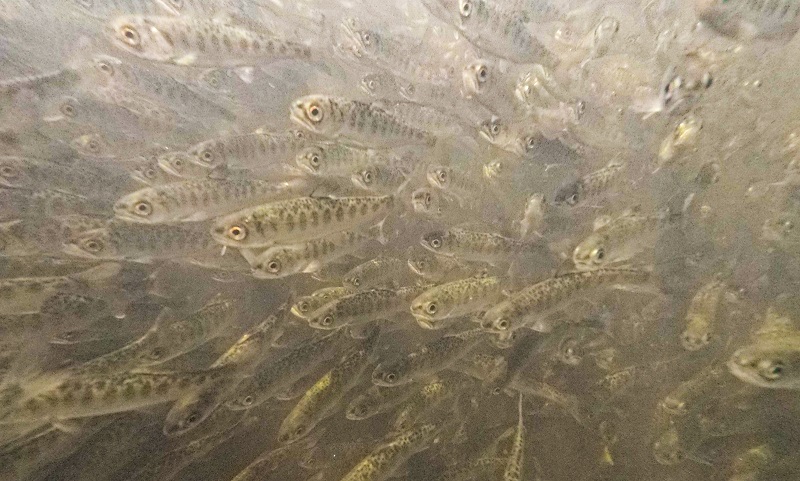
Juvenile Chinook salmon swim in a raceway at Iron Fish Gate Hatchery, Siskiyou County, Calif., before their relocation to the Fall Creek facility on July 7, 2021. (CDFW Photo/Travis VanZant)
Press release from the California Department of Fish and Wildlife (CDFW):
The California Department of Fish and Wildlife (CDFW) announced [yesterday] that fall-run Chinook salmon fry released for the first time from its Fall Creek Fish Hatchery in Siskiyou County are presumed to have succumbed to gas bubble disease in the Klamath River.
On Monday, Feb. 26, CDFW released approximately 830,000 fall-run Chinook salmon fry into Fall Creek, a tributary of the Klamath River above Iron Gate Dam. The fish were hatched at CDFW’s new, $35 million, state-of-the-art Fall Creek Fish Hatchery, which represents California’s long-term commitment to supporting and restoring both Chinook and coho salmon runs on an undammed Klamath River.
The salmon fry experienced a large mortality based on monitoring data downstream. Indications are the cause of mortality is gas bubble disease that likely occurred as the fry migrated though the Iron Gate Dam tunnel, old infrastructure that is targeted for removal along with the Iron Gate Dam itself later this year. Gas bubble disease results from environmental or physical trauma often associated with severe pressure change.
There is no indication the mortality is associated with other Klamath River water quality conditions such as turbidity and dissolved oxygen, which were reading at suitable levels on Feb. 26 and the days prior to release. The visual appearance of the dead fry detected by monitoring equipment points to gas bubble disease. Monitoring equipment documented other healthy yearling coho and Chinook salmon that came from downstream of the dam.
The problems associated with the Iron Gate Dam tunnel are temporary and yet another sad reminder of how the Klamath River dams have harmed salmon runs for generations. CDFW will plan all future salmon releases below Iron Gate Dam until this infrastructure is removed. Poor habitat conditions caused by the dams and other circumstances such as this are reasons why CDFW conducts releases of hatchery fish at various life stages.
CDFW’s Fall Creek Fish Hatchery continues to hold approximately 3.27 million healthy, fall-run Chinook salmon. Additional releases are planned later in the month.
The annual fall-run Chinook salmon production goal for the hatchery is to raise and release 3.25 million fish – 1.25 million released as fry, 1.75 million as smolts, and 250,000 as yearlings. The additional stock of fall-run Chinook salmon remaining in the hatchery exceeds the annual production goal and will help offset losses experienced with the initial release of fry.
###


Join the discussion! For rules visit: https://kymkemp.com/commenting-rules
Comments system how-to: https://wpdiscuz.com/community/postid/10599/
IMHO: Klamath river will be ‘out of commission’ for about 10 years after the destruction of the dams… and that depends on ‘normal’ rainfall. (Like this winter.) If the climate goes back into drought… recovery time will be a lot longer, if at all.
Why is your opinion on this worth anything?
What are you basing that opinion on?
>”The Klamath Dam will have much higher sediment outputs, making predicting the impacts much more difficult. Hinz explains, “The Klamath River Dam project is expected to increase the sediment load by 24-55% over the current Klamath River discharge of 5.83 million tons annually.”
>”Data-Driven Decisions: Tracking Sediment during the Klamath Dam Removal”It is possible that the increased sediment could have negative impacts on the environment. Crescent City, which is located downstream of the dam, is concerned about the potential burial of benthic species and blocked harbors. Hinz adds on that sedimentation in the water column could also impact the fish and submerged aquatic vegetation communities.”
Appendix E An Analysis of Potential Suspended Sediment …California State Water Resources Control Board (.gov)
https://www.waterboards.ca.gov › docs › app_e
—
>The downstream transport of this sediment, currently stored in reservoir deposits, can affect downstream habitats as both suspended sediment and bedload deposition. Elevated suspended sediment concentrations (SSC) may clog or abrade the gills of fish or prevent fish from foraging efficiently.
Think that Kym doesn’t like ’embedded links’.
You can search on “Sediment load downstream of Klamath dams.”
or “Harm to fisheries due to sediment load downstream of Klamath dams.”
—
I have a Bio Degree and worked for Cal Fish and Game/Pacific Marine Fisheries for a number of years. (Long ago.)
Have a pretty good idea how the agencies work… people on the ‘ground floor’ pretty much know what’s happening. A few levels up in the government… politics/money/ego raises it’s head. Same thing applies with business, medicine… etc.
It ain’t pretty, results is the messed up world we live in.
Biologists on charges of salmon restoration kill nearly a million by not considering environmental conditions at fish dump? Poor salmon haven’t a chance with imbeciles in charge
I don’t believe anything said about the Klamath, dropping the dams all at once instead of the months was a surprise and makes me lose trust.
This area is nothing like Elwa which sits in a rainforest, glaciers above, and no civilization with non source point pollution happening.
Time will tell and we hope for the best, but often we see in history the most vocal supporters are simply pawns and tossed on the scrap heap of history- it is The American Way.
Hope for heavy rain winters for the next ten years to turn things around.
It’s still very early in the river recovery process. I’m a civilian who is interested in fisheries recovery, and while I have only limited understand of fish biology, I know this is an emotional issue for people both for and against this and other dam removal projects. It’s awful to see wildlife die. On the other hand, it’s my understanding from listening to real fish biologists that even under the best conditions, salmon fry in this stage of life have something like a 1 to 3 percent survival rate even under best conditions, so, statistically, this is way less disastrous than it seems. And the problem appears to be something that will be corrected soon. For an observer who is not a fish specialist like me, it just seems too early to declare this project a triumph or a disaster. And, while we’re fulminating over this — it would be much more useful if the folks who comment on issues like this state their credentials. What’s your background in fisheries expertise? If you’re an interested observer, state how/why/where/when. Otherwise, actually, your comments are meaningless to me, altho I know it’s very satisfying to congratulate yourselves for slamming a project with a lot of science behind it.
It’s the general theme for lots of commenters here to come in with their minds already made up. They don’t read the articles seeking to broaden their breadth of knowledge, but rather, to pick out snippets that reinforce what they already believe.
This article mentions dead fish. And, even though the article is clear that the dam removal project had nothing to do with this event, they are already convinced that this project is bad, and every dead fish that turns up on the Klamath for the next ten years wil get attributed to the removal of the dams.
I’m no biologist, but hold several state licenses in pesticide applications including aquatics. It’s very early in the process, and I doubt we’d know the truth regardless. My guess is the river will never be open for fishing regardless of fish population, as most of the environmental types would rather everything remain untouched and will do everything to keep it closed, and tribal data will most likely be presented in such a way that only they can fish.
The concept taught in school decades ago, regarding question everything is now frowned on and anyone born after 1985 has been indoctrinated into the system and is not capable of free thought, generally.
Yeah sure they did. What a bunch of idiots.
It sure was foolish to have built those dams and the tunnel that is responsible for this fish kill.
But that was many decades ago.
I’m not sure it’s entirey fair to call them idiots.
google the attempted pike removal at Lake Davis in the late 90s. I was having dinner in Mohawk, started talking with the CFG crew implementing the approved kill plan, and told them exactly what would happen. They killed the trout, poisoned the water supply, and the pike was fine. The plan was to use TCE to kill the pike, TCE sinks in water. where does the trout live and where does the pike live? you would think they would know that since I know that.
I thought this was advertising a Fried Salmon Dinner in klamath