
First Step in Klamath Dam Removal Begins with Reservoir Drawdown
Press release from the Klamath River Renewal Corporation:
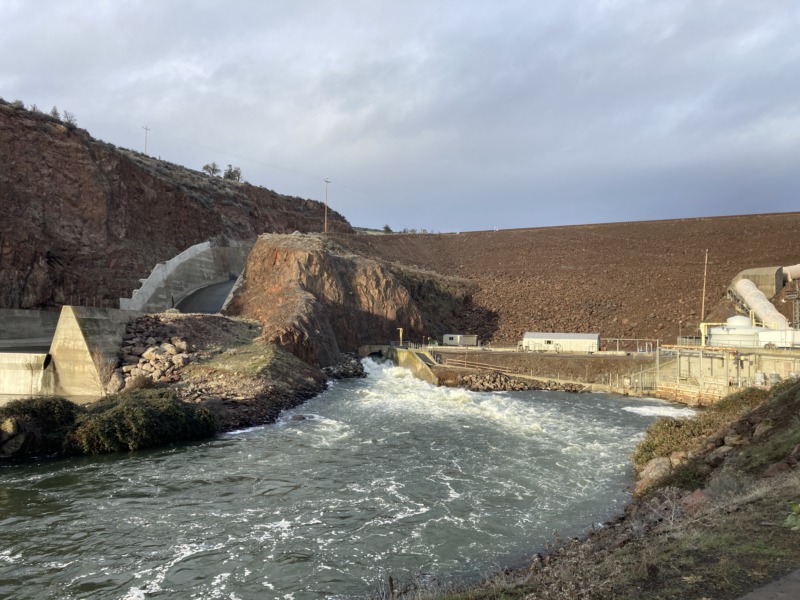
[January 11], the Klamath River Renewal Corporation (KRRC), initiated the drawdown process by opening the low-level outlet tunnel in the Iron Gate Dam. Drawdown refers to the slow draining of the water in the reservoirs, which will be lowered in a controlled manner through tunnels located at the base of the dams. Drawdown of the JC Boyle and Copco Reservoirs will begin later this month, and all reservoirs are expected to be drained by the end of February.
“Witnessing the beginning of drawdown at Iron Gate dam was both celebration of an important moment in the story of Klamath dam removal, and a source of pride for the exceptional work done by so many people to arrive at this day.” Said Mark Bransom, CEO of KRRC. Communities downstream of the dams will start to see changes in the river in the coming days, as sediment that has accumulated behind the dams is evacuated downstream. There is an estimated 17-20 million cubic yards of sediment behind Iron Gate, JC Boyle, and Copco No. 1, the three remaining Klamath dams slated for removal. During the drawdown process 5-7 million cubic yards is expected to go downstream during the initial phase of drawdown in January and February. Extensive testing done by the U.S. Environmental Protection Agency and KRRC consultants has determined the sediment to be non-toxic, mostly consisting of dead algae, gravels, and fine clay particulates. “Iron Gate’s drawdown strategy is different than what people may have seen in the past with other dam removals,” noted Bransom. “There was no blast at this dam, instead we had the opportunity to use existing infrastructure, which allows us to precisely control the volume of water going down river, limiting downstream impacts.”Iron Gate drawdown [Photo by Jason Hartwick of Swiftwater Films]
The initial drawdown period was carefully selected KRRC’s Aquatic Resources Working Group, which is comprised of Tribes, and state and federal agencies. January and February are the ideal months for this process, as there are the fewest threated and endangered species in the mainstem, and winter flows will assist with sediment evacuation.
While the initial phase of drawdown is expected to be completed sometime in February, because the reservoirs will be drained so slowly, they may refill a bit with spring run-off, and then need to drain again. Water quality is expected to improve in March, after the initial phase of drawdown is complete, but it will likely take up to 24 months for water to return to usual clarity, following the successful establishment of vegetation in the former reservoir footprint areas. Work on the deconstruction of the dams is expected to commence sometime in May or June of 2024 depending on the weather, and be complete by Fall, 2024.


Join the discussion! For rules visit: https://kymkemp.com/commenting-rules
Comments system how-to: https://wpdiscuz.com/community/postid/10599/
What about thenonnative fish in the reservoirs? They shouldn’t be allowed to escape downstream.
This is exciting to see.
Can’t wait for it to start happening on the Eel.
Hetch Hetchy next?
SF would have to build a desalination plant, I think, before that could happen. It would be amazing though.
Mulholland once said that if he could, he’d dam Yosemite Valley.
For a thorough and informative examination of the history of dam building in the Unites States, their environmental impact, and all the crazy politics going back decades, see: Reisner, Mark: Cadillac Desert. Also, but focusing more on Los Angeles and all that stuff with the LA Department of Water and Power gaining control of Owens Valley, Mulholland and all that, see: Nadeau, Remi: The Water Seekers. Really, an understanding of water resource politics is essential to an understanding of this country and this state’s history.
One can understand that the flooding of the beautiful Hetch Hetchy Valley broke John Muir’s spirit and eventually caused his death. The embers from the heated debates for and against obliterating the pristine wilderness still smolder.
pnuemonia
As I understand it, he waited outside in the rain, hat-less, for a train.
Caught a chill, that developed into pneumonia.