
Mendocino Railway’s Sister Company, Sierra Northern Railway (SERA), Takes a Giant Leap Towards a Greener Rail Industry.
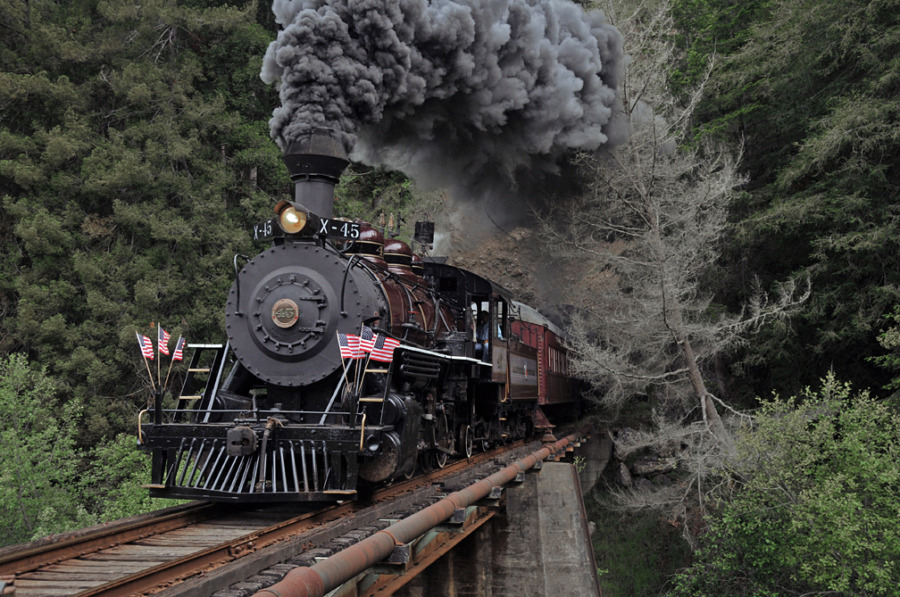
The Skunk Train 2009 [Photo from Drew Jacksich from San Jose, CA, via Wikimedia Commons]
Mendocino Railway is thrilled to announce that its sister company, Sierra Northern Railway (SERA), has been awarded significant funding from the California State Transportation Agency. This funding fuels a groundbreaking initiative to convert three diesel switching locomotives into hydrogen-powered, zero-emission locomotives, affirming SERA’s dedication to an eco-friendly future in the rail industry.
Adding to an existing project with the California Energy Commission, Sierra Northern Railway is already developing a hydrogen-fueled locomotive. With this new funding, they will broaden their green energy footprint with three additional locomotives, marking a pivotal advancement in the railway industry’s journey toward sustainable energy and emissions reduction.
Collaborating with the State of California, Port and Freight Infrastructure Project Funding, and the Sacramento Metropolitan Air Quality Management District, Sierra Northern Railway will use the approximately $19.5 million grant to develop, demonstrate, and stringently test these additional hydrogen-fueled switcher locomotives. A thorough assessment of these innovative locomotives will be conducted on a dedicated test track, to be built in SERA’s West Sacramento rail yard.
Mendocino Railway, a steadfast supporter of Sierra Northern Railway, expresses immense pride in this momentous achievement. “We are incredibly proud to witness Sierra Northern Railway being awarded these funds, as they continue leading the industry in converting their switching locomotives to hydrogen-powered, zero-emissions solutions,” said Robert Jason Pinoli, President of Mendocino Railway. “These forward-thinking partnerships, like the one with the Sacramento Metropolitan Air Quality Management District, align seamlessly with the State of California’s vision of achieving a zero emission solution for all switching locomotives.”
Embracing Mendocino Railway’s vision, the incorporation of hydrogen technology represents a significant step towards phasing out old higher-emission diesel locomotives (Tier-zero) and integrating more sustainable solutions. “We have several low-emission Tier III Genset locomotives ready to be brought to Willits for service. However, the state-owned NWP railroad remains closed, blocking our ability to bring them beyond Windsor.”
In collaboration with their sister company, Sierra Energy, a premier gasification technology developer, Sierra Northern Railway will examine opportunities to fuel its new zero-emission hydrogen-powered locomotives with clean hydrogen produced from discarded rail ties. Sierra Energy specializes in the development and deployment of advanced clean energy technologies. Its FastOx® gasification technology converts a wide variety of waste feedstocks into clean syngas, which can then be transformed into green hydrogen, as well as other clean energy and chemicals such as green methanol, green ammonia, and renewable natural gas (RNG).
This ambitious project is made possible by the cooperation between numerous stakeholders, including Sierra Northern Railway, Sacramento Metropolitan Air Quality Management District, Railpower Tech LLC, Ballard Power Systems, Velocity Strategies, Gas Technology Institute, WHA International, UC Riverside, College of Engineering – Center for Environmental Research and Technology, and Valley Vision.
Sierra Northern Railway, Mendocino Railway, and Sierra Energy are all wholly-owned subsidiaries of Sierra Railroad Company. Overall, Sierra Railroad operates 186 miles of track in California, providing essential transportation to a diverse range of customers.
For more information about Mendocino Railway, Sierra Northern Railway, Sierra Energy, and their innovative initiatives, please visit http://www.
sierrarailroad.com. For additional information about Sierra Energy and its advanced clean energy technologies, please visit http://sierraenergy.com/


Join the discussion! For rules visit: https://kymkemp.com/commenting-rules
Comments system how-to: https://wpdiscuz.com/community/postid/10599/
We all love those old time steam locos, but, the pollution! Why couldnt these old locos be repowered with electric or H & a steam generator fitted to give us that fun billowing cloud from the stack. I would think CARB would be onboard and be happy to provide some cash towards such a project. The EPA too would want to help. maybe.
Just a Thought…
!
I’ve seen an old Shay on Colorado that ran on vegetable oil, smelled like french fries.
This does not seem like an appropriate use of tax money to me.
Jobs and decarbonization.
and liquid ‘green’ fuel that would power i.c.e.’s.
If it were going to be some sort of commuter rail, I’d be more supportive of it.
Bard:
The protective polymer used to prevent hydrogen gas from leaking out of tanks used in hydrogen powered trains is polyimide. Polyimide is a high-performance polymer that is strong, lightweight, and resistant to chemicals. It is also a good insulator, which makes it ideal for use in hydrogen tanks.
Polyimide is typically used as a liner in hydrogen tanks. The liner is bonded to the tank walls, and it prevents hydrogen gas from leaking out. The liner is also resistant to the corrosive effects of hydrogen gas, which helps to extend the life of the tank.
In addition to polyimide, other polymers that are used to prevent hydrogen gas from leaking out of tanks include fluoropolymers and epoxy resins. Fluoropolymers are also strong, lightweight, and resistant to chemicals. Epoxy resins are not as strong as polyimide or fluoropolymers, but they are more resistant to heat.
The type of polymer that is used to prevent hydrogen gas from leaking out of a tank depends on the specific application. For example, polyimide is often used in hydrogen tanks that are used in high-temperature environments, while fluoropolymers are often used in hydrogen tanks that are used in corrosive environments.
Here are some of the benefits of using polyimide as a protective polymer in hydrogen tanks:
High strength: Polyimide is a very strong polymer, which makes it ideal for use in high-pressure tanks.
Lightweight: Polyimide is a lightweight polymer, which helps to reduce the weight of the tank.
Chemical resistance: Polyimide is resistant to a wide range of chemicals, including hydrogen gas.
Insulating properties: Polyimide is a good insulator, which helps to prevent heat loss from the tank.
Overall, polyimide is a good choice for use as a protective polymer in hydrogen tanks. It is strong, lightweight, resistant to chemicals, and has good insulating properties.
A hydrogen atom is the simplest and lightest atom, consisting of only one proton and one electron. This makes it very difficult to construct a tank for hydrogen that does not leak.
Hydrogen is also quite explosive (eg: Hindenburg was filled with hydrogen).
Having a leaky tank filled with explosive cuz is certain disaster.
Using hydrogen in trains is an affordable way to field test hydrogen as a fuel cuz train engines are so expensive.
Using hydrogen as a fuel is an enormous challenge but is enticing cuz there is a vast amount of hydrogen on earth, it should be clean (much much better than toxic batteries), and it will be must faster to refuel with hydrogen than batteries.
Where is this “vast amount” of hydrogen. As an electronics instructor I am anxious to know.
Everywhere, hydrogen is the third most abundant element on Earth and the most abundant element in the universe.