
New Analysis for Offshore Wind Energy Development of Humboldt and Mendocino
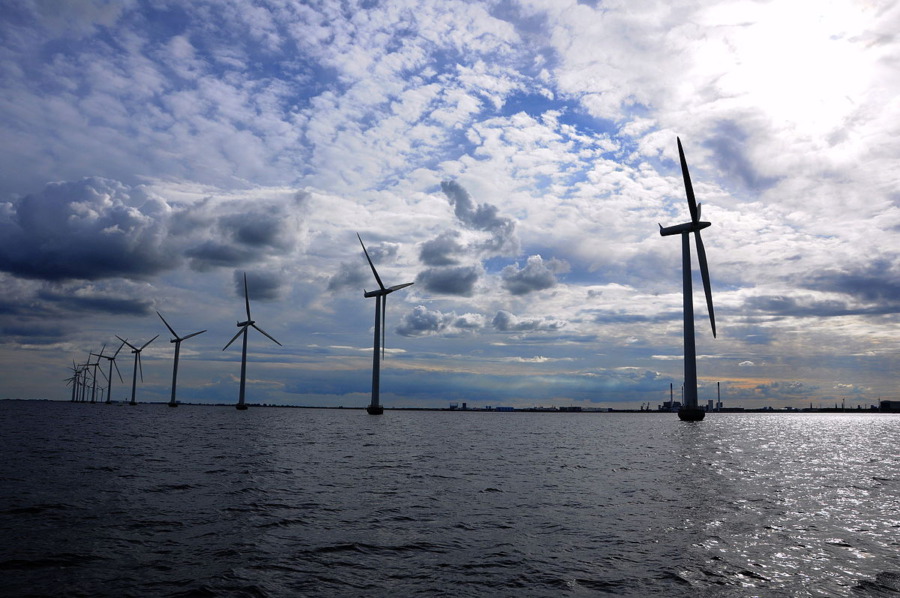
[Stock photo from Wikipedia Commons, image by Martin Nikolaj Christensen from Sorø, Denmark]
.jpg)
Point Blue, a leader in environmental research and conservation, has released a new analysis aimed at guiding the sustainable development of offshore wind energy off the coast of California. The analysis identified sites offshore from Mendocino, Humboldt, and Santa Barbara counties as having high wind energy potential and with lower potential environmental impacts. The project represents a significant step forward in understanding how to balance renewable energy goals with the need to minimize impact to the marine environment and the communities that depend on it.
This report is released at a crucial time, with the California Energy Commission (CEC) soon to conclude the public comment period for the Offshore Wind Strategic Plan, pursuant to Assembly Bill 525. This plan is aimed at reaching Governor Newsom’s proposed target of 25 GW by 2045.
The comprehensive analysis, spearheaded by Point Blue’s team of experts, utilized updated spatial data to assess the potential impacts of offshore wind energy development on marine environment, and human uses of the ocean. The model inputs included 180 datasets of marine birds, mammals and turtles, fish, habitats, and human uses. In addition to these datasets, Point Blue received 191 responses from expert surveys to quantify sensitivity to offshore wind impacts for all species.
By combining data on species abundance, habitats, and human activities with expert-derived information on sensitivity to negative impacts, the analysis identifies areas that maximize energy generation potential while preserving ocean ecosystems and existing uses.
“Our goal is to provide decision-makers with the information they need to make informed choices about offshore wind energy development,” says Dr. Jaime Jahncke, Director of the California Current Group at Point Blue. “We want to help California meet its renewable energy targets while minimizing harm to wildlife and habitats.”
Key findings from the analysis include the identification of priority wind energy installation areas off Punta Gorda (Humboldt County), Point Arena (Mendocino County), and Point Conception (Santa Barbara County). These areas, selected based on rigorous modeling and optimization analyses, offer high energy production potential while minimizing impacts on species and habitats.
“One of the things that surprised us the most about the results was that there are some clear areas that have a good mix of high energy generation benefit and lower marine impacts. The big challenge will be making development there technically and economically feasible and ensuring conflicts with emerging uses like new shipping fairways are addressed,” said Cotton Rockwood, a Senior Marine Ecologist who led much of the analysis in the report.
The analysis also examined individual sea space regions identified in California’s AB525, which guides the California Energy Commission in the development of offshore wind resources. Within the priority areas identified in that legislation, the analysis identified AB525 Mendocino Area_1 sea space region as the highest priority area for the next phases of wind development offshore of California. In addition, portions of the Mendocino Area_2, and both Humboldt Area sea space regions should be considered high-priority for development plans to meet the AB525 2045 goals. These areas comprise waters with high energy production, balanced and minimized combined impacts to species, habitats and existing human uses and reasonable access to grid interconnection.
The analysis is intended to inform the roll-out of offshore wind in California that will occur in the coming decades, so it intentionally omits some current limits on the technical capacity for floating wind installation, like a maximum current depth of 1300m. That is because floating wind infrastructure is evolving rapidly and installation may well be possible in deeper waters well before future lease areas are developed. This means that important planning and investment decisions will determine whether deeper-water development can be achieved along with the lower impacts and greater benefits those areas accrue.
Funding for the report was provided by the Ocean Protection Council with additional support from the Gordon and Betty Moore Foundation and The David and Lucile Packard Foundation.
To read the full report, visit: https://www.pointblue.org/tools-and-guidance/research/updated-report-offshore-wind-energy-areas/


Join the discussion! For rules visit: https://kymkemp.com/commenting-rules
Comments system how-to: https://wpdiscuz.com/community/postid/10599/
I’m all for green energy including offshore wind but can we put them just out of sight over the horizon where we dont have to look at them whenever we come to the beach to enjoy the ocean view? Also 20mi offshore, less birds will get whacked by them AND we would not have to listen to those whirring noises they make.
just a thought…
!
‘Current Plans’ have them 20 to 30 miles off shore.
Will it take doubling our electricity rates to get the private investment for the local project to go forward?
Varies depending on who ‘generated’ the estimate.
3X
>”On a kilowatt hour basis, offshore wind power is estimated to cost 22.15 cents per kilowatt hour, while onshore wind is estimated to cost 8.66 cents per kilowatt hour, and natural gas combined cycle is estimated to cost 6.56 per kilowatt hour.”
5X
>”According to recent LCOE estimates from EIA, the unsubsidized cost of offshore wind exceeds $120/MWh and is among the most expensive generation resources.”
US Government.
>”Goal: Reduce the cost of floating offshore wind in deep waters by more than 70%, to $45 per megawatt-hour1 by 2035.”
Uh huh…
There are 1000 kilowatt hours (KWh) in a megawatt hour (MWh). So, according to the estimates above and converting MWh to KWh values, the LCOE estimate would be 12 cents per KWh. The goal would be to reduce the cost to 4.5 cents per KWh by 2035.
Yep, estimates vary widely.
Just say NO to OFFSHORE WINDMILLS OFF the Humboldt County Coast
Your display is dishonest,
I maintain my support for off shore wind generation,
The alternative is gruesome.
Deepwater Horizon, Gulf of Mexico.
Wind turbines have long garnered scrutiny for killing birds that fly into their spinning blades or tall towers. Much of the data about bird deaths at wind facilities in the United States comes from studies published in 2013 and 2014. Those studies gave a wide range for the number of birds that die in wind turbine collisions each year: from 140,000 up to 679,000.1 The numbers are likely to be higher today, because many more wind farms have been built in the past decade.
With citation. This is a 10 year old study and the actual data would be over double of this today as there are twice as many windmills today.
1 Loss, Scott R., Tom Will, and Peter P. Marra, “Estimates of bird collision mortality at wind facilities in the contiguous United States.” Biological Conservation, Volume 168, 2013,
That’s why this project is offshore.
Both f the images you’ve posted are on-shore.
Even the uncredited study you referenced is about onshore.
I would like to see some plans on engineering for these floating platforms. What kind of anchor and ballast will support these 600 foot high tower? 1300 m is is over 4000 feet deep.
How would you like to see the engineering on how to keep that windmill corrosion free after sitting 20 miles offshore for 25 years.
They are fooling themselves, and others, if they think Mendo and Humboldt have “reasonable access to grid interconnection.”
Massive substations… massive power lines out of the area.
Follow the money.
Those blades need to be kept spinning lest the ball bearings be crushed under their own weight. Will they use electric or diesel generators on windless days? If diesel, what protections are in place to reduce spillage? If electric, for how many windless days can they be kept spinning before the batteries are depleted?
I’m more than a little skeptical on the crush bearings thing.
Yeah. I’m pretty sure the bearings are engineered to include non-rotational periods. But I’m not an engineer. Just spouting off.
I’ve seen hundreds of wind turbines sitting motionless.
Nebraska has literally hundreds of miles of those big suckers turning steadily seems to work just fine. Along hwy 20….
They clutter up the countryside taking away the land for other usage. Our power bills continue to rise. What worth do they have? They need wind to make energy. They are massive, what do they do to landfills or are they dumped in the ocean and what affect does that cause? If we scaled back on immigration, birth rates are down, we would not need so much power. Let the millionaires building islands produce and pay for their own.
The diagrams that I have seen indicate roller bearings, not ball bearings. Try sources other than social media for facts.
another article that fails to address the impact to the bay. everyone bitches about seeing them 20 miles out. you will be seeing them in our bay, several at a time, and for decades. my concern is the impact to the bay’s ecosystem. most animals will have a had time hitting the bait when the bait is hiding around these footings. and the increase in ship traffic and dredging. the recent productive years of calibuts will be over. no more sail boat races. i could go on and on with the impacts that these players don’t want you to know until it’s too late.
All this and they still have bot solved the problem of the leading edge on their blades which is a huge problem that according to experts renders wind turbines a negative net for power ie takes more to produce install and maintain then they will create
There have been an awful lot of dubious claims about this project,
but suggesting that the wind turbines would result in a net loss of energy
seems amongst the more ridiculous of them.
To be net positive the windmills would need to be 100 percent effective for 20 years , their current tech and material abilities is hardly that , but just as with the prius the sheep follow the advertising and it is not till a few decades later that logic proves the advertising is crap and people are gullible yet by then there is new advertising that people blindly follow refusing think critically and demand answers based upon results of such . And then we wonder why thing got so bad and look for someone or something to blame and cant figure out why more people are not outraged at the situation we find ourselves in
In medium winds, our V136-4.2 MW turbine hits this breakeven period within 6.1 months and in low winds, the V150-4.2 MW turbine will hit energy neutrality within 7.6 months. As this graph illustrates, a Vestas wind turbine (V117-4.2 MW, 136-4.2 MW, V150-4.2 MW) pays back more energy than it uses after 5 to 8 months.
Google-
Provide sources please to include extraction shipping maintenance and decommissioning
Many times people have stumbled into the manure pit on their way to utopia.
South America is a prime example.
https://www.sciencedirect.com/science/article/pii/S2352484720315298
if you take the time to read this and the assorted citation reference’s you can clearly see if you add in the leading edge problems and loss of efficiencies that you will be hard pressed to come up with a balance of power produced verses used using the off shore citations the math doesnt add up , and oh by the way new problem with off shore wind farms is the new problem of there not being enough ships currently to install and maintain said farms so add in the cost of producing said required ships their crews and their fuel
My understanding of the ship issue is that it’s not a lack of ships, per se, but that a law requires that the ships be US-flagged and US-crewed. And, since the US is so late to the game, we don’t have enough of our own ships and crews to do the job.
Ships are being built, but it’s the law that created the problem in the first place.
And so it goes the resources and what it takes to extract and ship that are required to build the ships should also be included in the total cost of production . How much ghg c02 environmental damage will all of this cost ? Can it ever be recovered ? These are things that should/need to be answered prior to building anything yet because it is the current trendy trend passes are allowed exemptions made and in the end we are left with a bunch of landfill rusting and rotting away in our oceans perfect solution right ? Rather than come up with solutions before we should rush ahead and jump through our asses later to come up with some patch that makes it not as bad but by then these companies will be long gone corporate raiding already have taken place and we the rate and tax payers will be on the hook yet again as with everything else
Cotton Rockwood is one hell of a name
https://hackaday.com/2022/10/05/leading-edge-erosion-when-precipitation-destroys-wind-turbine-blades/ Just one of many links that proves these wind farms are more hype than real in their claims , and as you can see 2 to 4 percent lost per year on average conditions , i think 20 miles off shore will have far more wind spray water droplets than what they call average . And if you read further they say repairing the leading edge with tape just the weight and drag from the tape reduces output by another1.2 percent if it is perfectly applied which would add together as it needs to be reapplied every year so that is a total of 3 to 6 percent lost per year until the blade must be replaced . Now think about how loud a indy car is . 224 mph is how fast they 224 mph is what these turbine blade tip speeds will run , think about a 30 ft blade spinning at 224 mph how much noise that will create , now times that by 50 or 200 and that is what these bone heads are wanting to put out in the middle of nature . And that is just the turbines , that is not all the ships the cables the substations etc we are talking about massive destruction on a scale equal to the years of logging redwoods and most seem to support this ? All for what ? A net loss of power come on folks you have got to be smarter than the short term picture
The North Sea wind turbines seem to be doing OK.
And the EU is investing in more.
We need to look at how and what they are experiencing there.
Notice the difference? The most recent earthquakes in the North Sea are years ago. The most recent in the Pacific Northwest is hours ago. The biggest earthquakes in the North Sea are of a size barely noticed in the Pacific Northwest and occurred decades ago. And where is Humboldt Country? Why smack dab in one of the worst locations.
Then tsunamis- the destructive ones are spoken of in terms of millennia in the North Sea and in terms of centuries in the Pacific Northwest. You won’t find any Tsumani evacuation signs in Denmark. Probably because a Tsunami near Denmark would cover the whole country which is flat as a pancake if it ever occurred. Which it hasn’t in the last 8000 years.
We are not the North Sea.
https://earthquaketrack.com/r/north-sea/recent
https://earthquaketrack.com/v/pnw/recent
What do earthquakes have to do with floating offshore wind turbines?
Probably nothing in Progressiveland where things just magically happen when a law is passed. But for real world dwellers, the research is not in existence yet. I suspect which is why the builders of these farms are building them for sale to unknown yet operators and not for running themselves. The learning curve will be steep and expensive. They don’t want to be left with the results.
https://www.dnv.com/news/dnv-launches-new-joint-industry-project-to-tackle-earthquake-challenges-for-wind-farms-242844
https://www.researchgate.net/publication/352212853_Seismic_Design_of_Offshore_Wind_Turbines_Good_Bad_and_Unknowns
If you follow the links i have posted you will see that my research is based upon the EU ‘s problems
It is a known fact that offshore wind farms require more complex infrastructure to support them and, as a result, are more expensive to construct. Higher wind speeds, strong seas and accessibility issues makes offshore wind farms more challenging to maintain. Building large-scale wind farms in the ocean is less cost-effective than onshore construction. The construction process requires more materials, workers, and installation steps, which increase production costs. Turbine installation can also damage aquatic environments.
Cons of Offshore Wind Power
Building large-scale wind farms in the ocean is less cost-effective than onshore construction. The construction process requires more materials, workers, and installation steps, which increase production costs.
Turbine installation can also damage aquatic environments. Drilling into the ocean floor may destroy natural habitats and pollute areas with debris. Turbines also produce sound pollution, which affects marine creatures’ health. Noise pollution can disorient aquatic species and leave them vulnerable to predators.
High wind speeds and wave impacts can degrade turbines’ efficiencies over time. Offshore turbines may require more frequent and invasive maintenance practices than onshore systems. Damaged parts also cause landfill pollution due to their low recyclability rates.
The final disadvantage of offshore wind farms is surface-level biodiversity loss. In America, turbines cause about 538,000 bird deaths annually
seas off the vineyard for Sat. (current Vineyard Wind location)
SAT NIGHT
W winds 15 to 20 kt with gusts up to 30 kt. Seas
4 to 6 ft. Rain likely. Vsby 1 to 3 NM. (almost always 10-12 seconds which is why NOAA leaves it out)
seas off Eureka for Sat. (proposed Vineyard Wind location)
SAT
W winds 15 kt. Waves W 10 ft at 11 seconds…and N 3 ft at 13 seconds.
In the winter we experience many days where it is around 21 feet at 17 seconds and the bar is closed.
The advantage to offshore wind is that it has not been shown to kill birds (or whales.)
Cite your sources, please. You obviously didn’t write this yourself. Looks like ChatGPT.
If this project is completed, what will be the rate we pay locally per kWh be?
Two Bucks.
His project will depend on huge government subsidies which equals waste!
The Levelized Cost of Energy (LCOE)
LCOE is a straightforward way to get a sense of the levelized (or averaged‐out) cost of a standalone power plant. According to recent LCOE estimates from EIA, the unsubsidized cost of offshore wind exceeds $120/MWh and is among the most expensive generation resources.Jan 10, 2024
Funny how folks complaining about wind costs never seem to mention the subsidies we have given, and continue to give, fossil fuels.
For example, worldwide in 2020 we gave fossil fuels $5.9 Trillion in subsidies according to the report referenced here
https://e360.yale.edu/digest/fossil-fuels-received-5-9-trillion-in-subsidies-in-2020-report-finds
Much of that is in the health and environmental costs we have to pay for the consumption of fossil fuels.
Failure. Go away! Take a hike. Sayonara!
Why not build a small version of what is being proposed and test its impact on the environment over an extended period of time? The smaller facility could provide electrical energy, for example, to Fort Bragg or Crescent City.
They already have.
There are thousands of offshore wind turbines, both floating and fixed-bottom, with the first having been installed for more than 30 years.
Sure, there are lots of engineering challenges to be worked out, but their impact on the environment has been thoroughly studied and has been found to be negligible.
Suuuuurrreee. Yup. Except for the fact that none like what is being proposed here has ever been done. And the first one that succeeded in the US just started operation on the east coast. A much more stable place than here.
Yet “Last year brought challenges for the nascent U.S. offshore wind industry, as Ørsted and other developers canceled projects in the Northeast that they said were no longer financially feasible. High inflation, supply chain disruptions and the rising cost of capital and building materials were making projects more expensive as developers were trying to get the first large U.S. offshore wind farms opened.”
The North Sea, which is the only place with experience, is “is a shallow shelf sea system in which the interactions between bathymetry, tides and a strong freshwater supply at the continental coast foster a complex frontal system, which separates well-mixed coastal waters from seasonally stratified deeper areas. The shallow coastal areas and sandbanks combined with stable wind resources make the North Sea an ideal area for renewable energy production and have made the North Sea a global hotspot for offshore wind energy production…” In other words, not here.
https://www.nature.com/articles/s43247-022-00625-0
https://www.npr.org/2024/03/14/1238593852/first-large-offshore-wind-farm-opens-long-island-south-fork
Is this technology going to lower your rates? Bring tourism to your area? What are your benefits? What is the long term scenario? Where does it stop? They take your land, they take your sea, what do you or your grandchildren have ?
Thinking about this discussion – maybe the windmill is not the object of the corporadoes. They start with a mega million port development grant, right? When Goldman Sacks made a bid to the Harbor Commission, they turned it down. So, throw in a global emergency saving off-shore wind farm and all the players line up to say yes. Port gets built, Samoa industrial sites are readied with cranes, and CHAZAMM they switch to some other polluting shipping scheme they wanted all along. And the Harbor Commission thinks they’re doing us a favor.
6 GOOD REASONS TO RALLY AGAINST OFFSHORE WIND TURBINES ON THE MENDOCINO AND HUMBOLDT COAST!
1. **Environmental Impact**: Despite being a renewable energy source, the installation and maintenance of offshore wind turbines can still have negative consequences on marine ecosystems. This can include disruption of migratory patterns of marine animals like whales and dolphins, as well as potential disturbances to seabed habitats.
2. **Visual Impact**: Offshore wind farms can be seen from shorelines, and some people find them visually unappealing. This can have implications for tourism and property values in coastal areas where wind farms are installed.
3. **Cost**: The initial costs of constructing and installing offshore wind turbines are high. Additionally, the maintenance and repair of turbines in harsh marine environments can also be costly. These expenses may ultimately be passed on to consumers through higher electricity prices.
4. **Intermittency**: Like other renewable energy sources, such as solar power, offshore wind energy generation is intermittent and dependent on weather conditions. This means that energy production can fluctuate, potentially leading to issues with grid stability and reliability.
5. **Safety Concerns**: The remote location of offshore wind farms can pose safety challenges for maintenance personnel. Working in harsh offshore conditions can be dangerous, and emergencies may be more difficult to respond to compared to onshore wind turbines.
6. **Potential Conflicts**: Offshore wind projects can face opposition from various stakeholders, including fishing communities, recreational boaters, and environmental groups. Conflicts over the use of ocean space and resources can arise, which may delay or even halt the development of offshore wind farms.
Additionally, The California coast presents challenges for offshore wind turbines due to its complex oceanographic conditions, including deep waters, strong waves, and high wind speeds. These factors can make it more difficult and costly to install and maintain offshore wind projects compared to other regions with more favorable conditions. Additionally, the regulatory environment in California can also be more stringent, which can further complicate the development of offshore wind farms in the area.
If you google how many are hit by lightening, the photos are stunning! Spinning wheels of oily fire that last for days until it all falls into the ocean. They also want to build a huge facility here to manufacture these monstrous things, how eco groovy is that?