
Evacuate! Humboldt County Issues New Orders and Warnings August 11
 Information from the Humboldt County Office of Emergency Services 8/11/2022 ?? 1:30 ?? :
??? ?????????? ????? issued for zone HUM-E032-B, northeast of Willow Creek. Residents in this zone should evacuate now. There is no immediate threat to Willow Creek proper.???? ???????????HUM-E032-BNORTH OF Forest Route 7n02SOUTH OF Horse Linto Creek RoadEAST OF Horse Linto Creek RoadWEST OF Forest Route 7n10??? ?????????? ??????? issued for zone HUM-E032-A, northeast of Willow Creek. Residents in this zone should prepare for potential evacuations, including personal supplies, overnight accommodations, and livestock considerations. Be ready to go at a moment’s notice.???? ???????????HUM-E032-ANORTH OF Forest Route 7n02, Forest Service North 7n31SOUTH OF Hoopa Valley ReservationEAST OF Bigfoot Scenic BywayWEST OF Forest Route 7n09???????? ??????????The following zones have been released from Wildfire Advisory status: HUM-E031, HUM-E032, HUM-E054, HUM-E055, HUM-E059, HUM-E060?????????? ???????A Red Cross Overnight Evacuation Shelter has been established at Trinity Valley Elementary School, located at 730 Highway 96, Willow Creek, for evacuees displaced by the Six Rivers Lightning Complex Fire.????? ?????? ???????A large animal shelter has been established at the Hoopa Rodeo Grounds, located at 1767 Pine Creek Rd., Hoopa.??????????? ???: community.zonehaven.com???? ?? ??? ??????: humboldtgov.org/alerts#SixRiversLightningComplexFire

Wildfire Evacuation Checklist and more:
When an evacuation is anticipated, follow these checklists (if time allows) to give your home the best chance of surviving a wildfire.
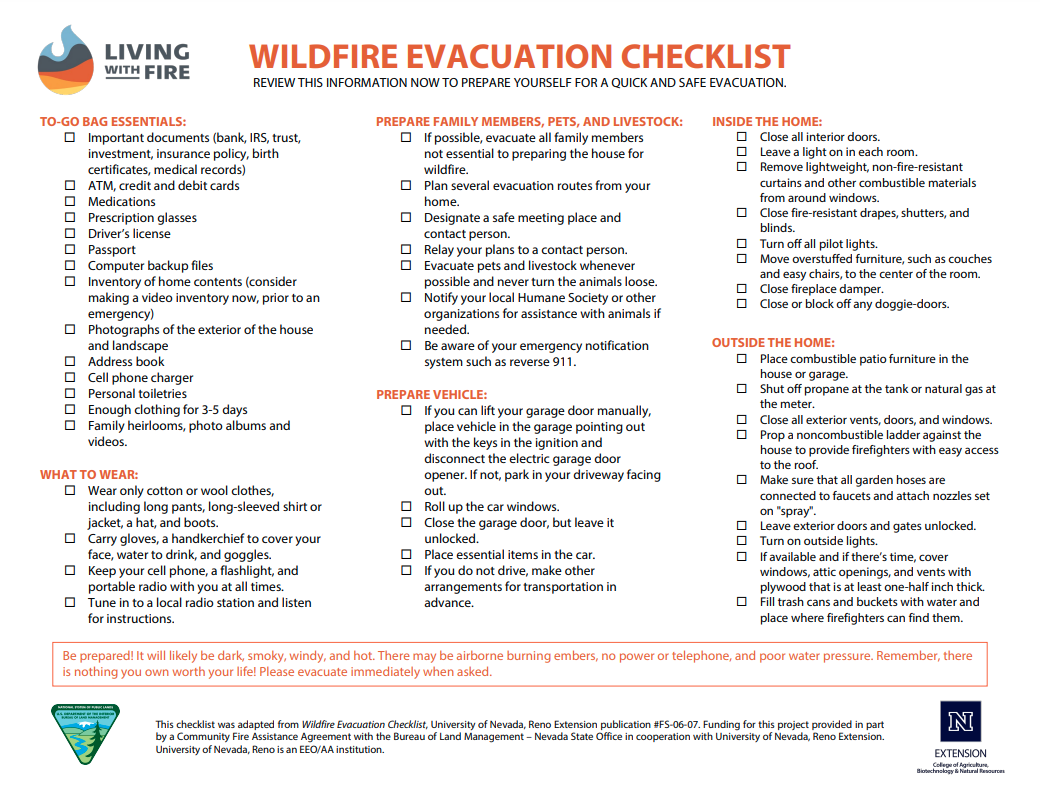
Home Evacuation Checklist – How to Prepare for Evacuation:
Inside the House
-
- Have your Emergency Supply Kit/Evacuation Bag ready to go. See checklist above.
-
- Ensure a Wildfire Action Plan is prepared ahead of time
-
- Make sure you know your community’s emergency response plan and have a plan on where to go when it is time to evacuate, and best routes for leaving your location.
-
- Shut all windows and doors, leaving them unlocked.
-
- Remove flammable window shades, curtains and close metal shutters.
-
- Remove lightweight curtains.
-
- Move flammable furniture to the center of the room, away from windows and doors.
-
- Shut off gas at the meter; turn off pilot lights.
-
- Leave your lights on so firefighters can see your house under smoky conditions.
-
- Shut off the air conditioning.
Outside
-
- Gather up flammable items from the exterior of the house and bring them inside (patio furniture, children’s toys, door mats, trash cans, etc.) or place them in your pool.
-
- Turn off propane tanks.
-
- Move propane BBQ appliances away from structures.
-
- Connect garden hoses to outside water valves or spigots for use by firefighters. Fill water buckets and place them around the house.
-
- Don’t leave sprinklers on or water running, they can affect critical water pressure.
-
- Leave exterior lights on so your home is visible to firefighters in the smoke or darkness of night.
-
- Put your Emergency Supply Kit in your vehicle.
-
- Back your car into the driveway with vehicle loaded and all doors and windows closed. Carry your car keys with you.
-
- Have a ladder available and place it at the corner of the house for firefighters to quickly access your roof.
-
- Seal attic and ground vents with pre-cut plywood or commercial seals.
-
- Patrol your property and monitor the fire situation. Don’t wait for an evacuation order if you feel threatened.
-
- Check on neighbors and make sure they are preparing to leave.
Animals
-
- Locate your pets and keep them nearby.
-
- Prepare farm animals for transport and think about moving them to a safe location early.
-
- Pets: https://www.livingwithfire.com/get-prepared/
Prepare for Pets
Prepare to address the needs of your pets if you have to evacuate.
-
- Make sure dogs and cats wear properly fitted collars with identification, vaccination, microchip and license tags.
-
- Your pet evacuation plan should include routes, transportation needs and host sites. Share this plan with trusted neighbors in your absence.
-
- Exchange veterinary information with neighbors and file a permission slip with the veterinarian authorizing emergency care for your animals if you cannot be located.
-
- Make sure all vehicles, trailers and pet carriers needed for evacuation are serviced and ready to be used.
-
- Assemble a pet to-go bag with a supply of food, non-spill food and water bowls, cat litter and box and a restraint (chain, leash or harness). Additional items to include are newspaper and paper towels, plastic bags, permanent marker, bleach/disinfectant solution and water buckets.


Join the discussion! For rules visit: https://kymkemp.com/commenting-rules
Comments system how-to: https://wpdiscuz.com/community/postid/10599/
How do you get neighbors to cut there jungle? One has brush up to the top of there chimney and uses it.
You can turn them into Cal Fire for the dangerous problem around their house. Cal Fire can force them to clean up or get out. I hope you don’t live next to them!
Can they?
Are they elderly or ill?
Maybe ask if they would like some help.
They might not have the health, skills, or tools to do what needs to be done.
Or no one will hire on to do the work, even if paid well. Ask them Bobo, before turning them in. Calling in the fuzz is the last option Martin.
Yup.
These fuckers are taking over willow creek. Blocking people from their own houses and we have to sleep in a tent in the school yard. Someone needs to start some fires elsewhere to get these leaches out of town. The only fighting they are doing is in the chow line at camp
Move out of cozy Willow Creek and out into the wilderness, and fight your own fires. The “leaches” are there to keep your remote suburbs from burning.
Joe, Get a life! These so called leaches are saving my friends & neighbor’s homes. If you’re at the Red Cross shelter at the school that’s because you choose to leave your residence. Maybe because you’d not put in the work to make your home fire resilient? Don’t bad mouth all the folks working hard & long hours to save our communities.
This isn’t something that one would be considering in the moment of preparing for evacuation, but I think that the design of landscaping can play a major role in spreading or resisting fires near your house. For instance, although I can’t verify if this is true, I’ve seen reports of wildfires that have come near houses but not reached them, because the flames were held back by a barrier of large cactus plants. It does seem like succulents are very fire resistant, more so than just what one would expect from the water in them alone.
A lot of homes in willow creek Border forest service land and they’ll fine the shit out of you if you cut one tree.
They dont fine you for doing fire hazard reduction and making a defensible space around your home. Pick up one of those fire safe booklets. They are free and you can get them at many grocery stores and other places
and yet the very same people are getting federal grant money to cut trees on public lands, and again for the timber they are harvesting under the vasod of fire suppression!!!
“but I think that the design of landscaping can play a major role in spreading or resisting fires near your house. ”
Wow you might be on to something. Check out the free “Living With Fire” handout. Maybe landscaping is something Californians should consider!
But seriously though, I have seen marijuana plants save a house that had fire bumping it. The plants were a loss.
In the early days of our Afghanistan campaign, Taliban fighters hid their ‘yotas from Canadian thermal imaging in a big field of cannabis. Coalition forces tried in vain to torch the field with flame throwers.
The ground can be scrapped bare without pot plants. If that’s what floats your boat. That is not pot saving a house. It was just serendipity if indeed all the plastic used by so many growers did not keep a fire burning hotter.
Good way to clean up illegal pot farms.
But the amount of toxins put into the air…
rather, no longer being aired out