
‘We Just Can’t Sustain That’: Federal Cuts Shake Southern Humboldt’s Healthcare Future

Proposed replacement hospital for SoHum Health [Rendering courtesy of Southern Humboldt Community Healthcare District]
The district’s current nine-bed Critical Access Hospital, built in 1961, serves roughly 1,000 square miles of rural Northern California, including a 125-mile stretch of Highway 101 where no other hospital exists. Administrators were preparing a federal USDA Rural Development loan application and expected to seek state approval for the project within months.
Then Congress passed H.R. 1. Known as the “One Big Beautiful Bill”, it was signed into law nearly one year ago on July 4, 2025. The budget reconciliation package included sweeping changes to federal health care funding.
Now, hospital administrators say extensive federal health care cuts included in the legislation have dramatically altered their long-term financial projections, putting the future of the replacement hospital, and potentially some local health services, into question.
“We’ve designed the new hospital as we’re preparing our projections for the USDA Rural Development loan application,” said Matt Rees, CEO of Southern Humboldt Community Healthcare District. “They were looking really good and we’re right in the middle of that and then HR 1 passed. And as we redid our projections in the 4th and 5th year, it’s not looking good.”

Matt Rees, CEO of Southern Humboldt Community Healthcare District [Screenshot from a video by SoHum Health]
“Some of the programs that are being cut are being cut as much as 35%. And we just can’t sustain that,” he said.
While many of the law’s largest Medicaid provisions have yet to take effect, hospital administrators, patients, and elected officials say its effects are already being felt in California through the expiration of enhanced Affordable Care Act premium tax credits, changing reimbursement forecasts, and growing financial uncertainty for rural providers.
Supporters of the law have argued it reduces federal spending, adds work requirements for some Medicaid recipients, and targets fraud and abuse within the Medicaid system. Critics counter that the legislation will reduce health care access for millions of Americans while placing additional financial pressure on hospitals that serve large numbers of low-income patients.
For one Southern Humboldt family, the effects were immediate.
Raven, a Southern Humboldt mother of two and small business owner who asked to be identified by her middle name, said she and her husband recently made the difficult decision to go without health insurance after the expiration of enhanced Affordable Care Act subsidies pushed their premiums beyond what they could afford.
Raven lives with endometriosis and polycystic ovary syndrome, conditions that have required multiple emergency surgeries.
“Affordable health insurance was huge for us,” she said. “With the extended subsidies being removed, we were not able to continue having health insurance.”
She said comparable coverage now would cost her family roughly $30,000 a year.
“You could finance a sailboat—a luxury sailboat—for the same price as what we would be paying for our health insurance premiums for the lowest health insurance plan,” she said.
Instead, the family decided to go uninsured and set money aside each month in hopes of covering future medical emergencies.
“Yeah, it’s life changing,” she said.
Her experience reflects concerns raised by Rep. Jared Huffman, whose congressional district includes much of California’s North Coast.
“The California Hospital Association estimates up to 1.8 million Californians could lose Medicaid insurance coverage,” Huffman said during a recent Protect Our Care news conference to mark the upcoming the one-year anniversary of H.R. 1.
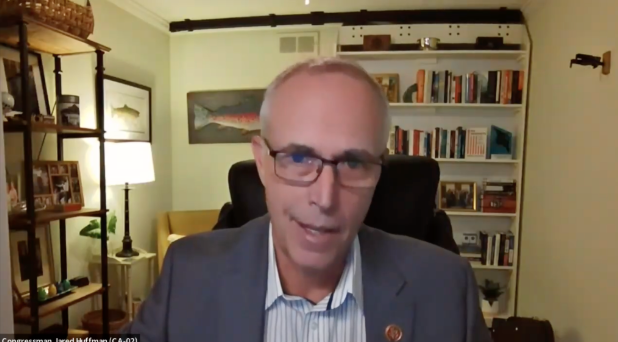
Jared Huffman, screenshot from video
“I’ve heard from constituents who are facing dramatic premium increases because of the loss of the ACA premium tax credit. They’ve been forced into really painful financial decisions just to keep the coverage they already had.”
Because much of his district is rural, Huffman said the consequences extend well beyond individual patients.
“These cuts put terrible strain on our community clinics, on healthcare providers, rural health systems that are already stretched thin,” he said.
Rees says Southern Humboldt exemplifies those concerns.
The district operates not only the hospital, but also an eight-bed skilled nursing facility, a rural health clinic, a pharmacy and optometry services that were added after the community’s only other private provider closed during the COVID-19 pandemic.
“We service about 1,000 square miles,” Rees said. “We service a 125-mile stretch of the 101 where there’s no other hospitals.”

Map of Jerald Phelps Community Hospital’s coverage area
If the hospital were forced to reduce services or close entirely, the consequences would extend well beyond Garberville.
“If we close because we can’t build a new facility, meet the seismic standards, and because financially we can’t make it because of these cuts,” Rees said, “there’s going to be a huge gap in care. Some of the people in our area are going to be 2.5, 3 hours away from care. And it’s just not acceptable.”
Rees says Southern Humboldt is far from alone.
“I’ve talked to other rural hospitals that are similar size to us in our state,” he said. “One of them was considering bankruptcy last fall. Another one is in bankruptcy, and another one is having the county help support them so they can make it financially.”
Closer to home, Rees also noted that another federally qualified health center in Southern Humboldt has already been impacted.”They made the announcement that they’re closing a couple of services. And so, hospitals, clinics, everybody is getting hit hard.”
Rees did not identify the clinic, but Southern Humboldt is served by only one other federally qualified health center: Redwood Rural Health Center. In a social media post, Redwood Rural announced it is making “strategic organizational adjustments.” 
Screenshot of a Redwoods Rural social media post.Kim Petersen, a Patient Services Manager who oversees public relations for Redwood Rural, said the clinic is also feeling the impacts of H.R. 1.
“Recent reductions in federal and state funding have required us to make some difficult adjustments so we can continue to deliver the essential care our community depends on. To protect the clinic’s long-standing mission, we are refocusing resources on primary medical and dental services and stepping back from programs that are no longer sustainable in the current funding environment.”
The affected program is Community Supports, which, according to the clinic’s website, provides case management, assistance accessing resources such as transportation, housing, and food, as well as support navigating healthcare and social services for people experiencing homelessness.
At this time, it is unclear how many employees or patients could ultimately be impacted by the cuts. However, the reductions affect services across the organization, including its clinic in Fortuna.
As a result, some of the community’s most vulnerable residents could lose access to Community Supports services, underscoring that the reductions extend beyond direct medical care.
“These decisions are made thoughtfully and with the well-being of our patients and staff at the forefront,” Petersen said. “Wherever possible, we are connecting affected patients with local partners and support services to minimize disruption in care.”
While some patients may still be able to access transportation through their health insurance, including Partnership HealthPlan of California or certain Medicare Advantage plans, others who rely on Community Supports for case management and help navigating healthcare and social services could lose access to those services.

Screenshot from Protect Our Care’s hospital crisis watch
According to Protect Our Care, a Democratic-aligned healthcare advocacy organization, both SoHum Health and Redwood Rural are part of a broader trend of healthcare systems across California that have already begun scaling back services or abandoning planned projects.
Protect our Care California points to seven public health clinic closures in Los Angeles County, Adventist Health’s withdrawal from a planned project in Clear Lake, and service reductions in Fresno and Clovis as early warning signs. The advocacy group says it is tracking more than 1,000 hospitals, clinics, nursing homes, and other health facilities nationwide that have either closed, announced closures, reduced services or identified themselves as financially at risk.
Matt Herdman, California state director for Protect Our Care, said rural communities are especially vulnerable because hospitals often serve as both essential health care providers and major employers.
“These hospital closures impact the entire community,” Herdman said. “So for those that have private insurance, they too will not have a place to go.”
He added that California already receives relatively low federal Medicaid funding compared with many other states.

Matt Herdman, California state director for Protect Our Care
“California receives bottom of the barrel in terms of federal funding per eligible Medi-Cal recipient,” Herdman said. “So we start in a place where folks are hanging on by a thread. HR 1 then takes that and then eviscerates what is left.”
Concerns about the impact on rural communities were acknowledged in the legislation, with Congress including a $50 billion “Rural Health Transformation Program”. According to the Centers for Medicare & Medicaid Services, the program was authorized by the One Big Beautiful Bill Act and is intended to “empower states to strengthen rural communities across America by improving healthcare access, quality, and outcomes by transforming the healthcare delivery ecosystem.”
CMS says the program “invests in the rural healthcare delivery ecosystem for future generations through innovative system-wide change” and created a funding distribution to ensure “a fair and consistent process across all 50 states.”
At first glance, the allocations appear to track with the overall size of each state’s award. However, when compared with state populations, the distribution raises questions about how equitable the funding is across states.
| State | Rural Hospital Funding | Population (2024 est.) |
| California | $233,639,308 | 39.4 million |
| Montana | $233,509,359 | 1.1 million |
| Alaska | $272,174,856 | 738,737 thousand |
| Texas | $281,319,361 | 31.7 million |
California received roughly the same amount of funding as Montana despite having more than 34 times the population.
As the nation’s most populous state, Rees questioned whether California’s share would be sufficient to provide meaningful assistance to small, independent rural hospitals like Southern Humboldt Health.
“We’re probably going to be a spoke on somebody’s wheel,” he said, “and I might get a little tiny piece of this when some of my services are being cut as much as 35%, and it’s just not sustainable.”
Regarding this year’s state budget, Rees also argues California has failed to keep pace with rising healthcare costs.
“They have not done increases to hospitals in over 13 years,” Rees said. “And you know what has happened with inflation over the last 13 years? Prices have doubled.”
But beyond the bottom line, Michelle Boucher DeMarino of Humboldt County wanted to make clear the debate over Medicaid is deeply personal.
“I just want to put a face on Medicaid,” she said.

Michelle Boucher DeMarino of Humboldt County
Speaking at a town hall with Huffman last year, Boucher DeMarino, who has multiple sclerosis, described how Medicaid -not Medicare- paid for two $30,000 wheelchairs after Medicare denied coverage. The program also pays for her caregivers, who allow her husband to continue working full time.
“It’s not just for poor Americans,” she said through tears. “I became disabled because I have MS, totally out of my control, and it is so important that we support Medicaid because you never know who’s the one getting benefits from it.”
Humboldt’s concerns are part of a growing warning being echoed across California. State Treasurer Fiona Ma and State Controller Malia Cohen say rural hospitals, which already operate under significant financial strain, will face service reductions or closure as federal health care cuts under H.R. 1 begin taking effect.
Speaking at a news conference earlier this month, the two officials said rural providers are expected to be hit hardest because they serve a disproportionate number of Medi-Cal patients while receiving fewer financial resources than hospitals in urban areas.
“Rural hospitals are also often the largest employers in the community,” said Cohen. “Hospital closures can lead to job loss and have an overall destabilizing effect on the local economy.”
Ma warned that as millions of Californians lose Medi-Cal coverage under the law, rural hospitals will likely see sharp declines in revenue while continuing to care for patients who can no longer afford insurance.
California State Treasurer Fiona Ma pointed to the Trump administration’s Medicaid cuts, rollback of federal health programs, and sweeping health care reductions in HR1, which she says have pushed facilities already operating on razor-thin margins past the breaking point.
The state’s fiscal stewards fear that patients lose access to emergency rooms and primary care, communities lose major employers, and states are left holding the bill. They are calling on the Trump administration to restore federal health investments and stop a “preventable crisis”.
Notably, many of H.R. 1’s most significant healthcare provisions will begin taking effect this fall and continue to phase in over the coming months and years.
Congressman Jared Huffman argued, however, that Republicans delayed implementation until after the 2026 midterm elections to avoid political fallout with voters.
Supporters of the law see it differently, saying it reduces federal spending, adds work requirements for some Medicaid recipients, and targets fraud, waste, and abuse within the program.
But Protect Our Care President Brad Woodhouse said the reality on the ground does not reflect that assessment.
He has estimated the law will result in as many as 15 million Americans and 1.7 million Californians losing health insurance. He argued that H.R. 1 pairs roughly $1 trillion in federal health care spending reductions with more than $1 trillion in tax cuts benefiting the nation’s highest earners over the next decade. ”
Health and Human Services Secretary Robert F. Kennedy Jr. defended the legislation’s investment in rural healthcare in a statement, saying, “More than 60 million Americans living in rural areas have the right to equal access to quality care. This historic investment puts local hospitals, clinics, and health workers in control of their communities’ healthcare.”
He added, “Thanks to President Trump’s leadership, rural Americans will now have affordable healthcare close to home, free from bureaucratic obstacles.”


Join the discussion! For rules visit: https://kymkemp.com/commenting-rules
Comments system how-to: https://wpdiscuz.com/community/postid/10599/