
Two New Decisions on the Potter Valley Diversion from the Eel River
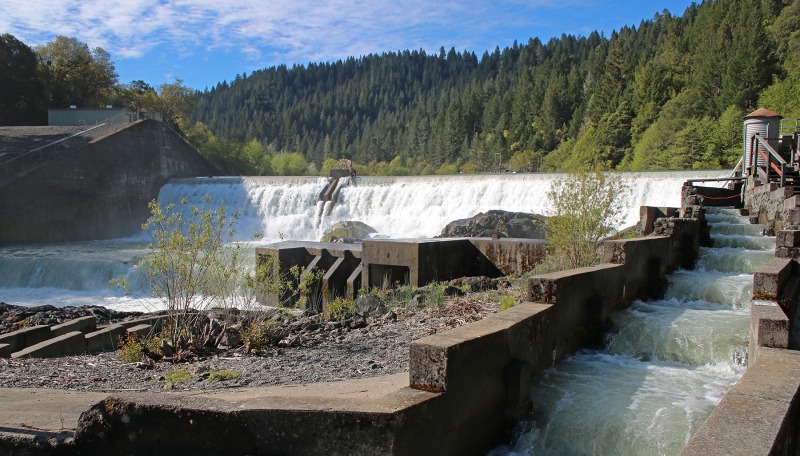
Van Arsdale Fisheries Station which is part of the Eel River diversion. [Credit: John Heil/USFWS]
On Wednesday, the Commission approved a drastic reduction in the flow of water through the Potter Valley hydropower project into the East Branch of the Russian River.
The Potter Valley Irrigation District will continue to receive 50 cfs on demand, but the flow of 75 cfs into the East Branch has been reduced to 5 cfs. The variance is effective immediately, and the change started to go into effect by 2:00 on Thursday afternoon.*
PG&E still owns the project, though it recently submitted a 30-month schedule for decommissioning, which FERC approved. PG&E argued that it needed to reduce the flow in order to preserve the infrastructure at Lake Pillsbury, as well as cold water pools at the bottom of the reservoir for fish habitat.
The National Marine Fisheries Service (NMFS), declared that if the water levels in the lake went down below 30,000 acre feet, the water would get too hot for juvenile salmonids. Though there is no fish ladder at Scott Dam, which impounds Lake Pillsbury, there is a needle valve at the bottom of the dam. The valve releases water into the 12-mile section of the Eel River between Lake Pillsbury and the van Arsdale Reservoir, near the diversion tunnel that directs the water into the Russian River.
Charlie Schneider is the coordinator with the Salmon and Steelhead Coalition, a partnership among Trout Unlimited, California Trout, and the Nature Conservancy. He said early models indicated that, in order to preserve the cold water pools, the variance should have been implemented by July 15.
“We’re glad the variance was finally approved, but I think we need to better understand and look at those models to really see what’s going to happen later this summer,” he said; “to see if it is in fact too late.” He added that conservationists are interested in preserving the 30,000 acre-feet of storage in Lake Pillsbury because in “big, deep reservoirs, the water stratifies, and the water in bottom part of the dam is cooler than the water at the top…the more water you’re able to retain in there, the more cold water there is in the bottom of the lake. And that’s the water that gets released from the low-level outlet. So it’s really about preserving water temperature in that 12-mile reach between Scott and Cape Horn dams, making sure that water’s a cool enough temperature to be habitable for salmonids.”
Elizabeth Salomone, General Manager of the Mendocino County Russian River Flood Control and Water Conservation Improvement District, expects drastic changes for human water users on the other side of the diversion tunnel. “It’s unusual for curtailments to cut into what we call the pre-1914 grouping,” she noted. “We do expect the curtailments to cut back into that pre-1914 category. But we won’t know for sure until the State Water Board issues their findings and curtailment notices.”
Salomone expects the state will allow Upper Russian River water users enough water to meet human health and safety needs, which is 55 gallons per person per day. Some urban water suppliers have other sources, including groundwater or recycled water. And some farmers as well as urban centers have contracts to divert stored water from Lake Mendocino.
“So not everyone will go completely without water,” she concluded.
The Commission also delivered an ambiguous opinion refuting the claims of environmental groups that the Commission has the authority to amend the Potter Valley Project’s new annual license to include more protection measures for wildlife.
The license for the Project expired on April 14. Within days, a group of conservationists and fishermen filed a 60-day notice of intent to sue PG&E under the Endangered Species Act. At the time, Redgie Collins, the Legal and Policy Director for California Trout, one of the coalition threatening the lawsuit, said that with the expiration of the license, PG&E “can no longer harm, harass, directly kill or injure salmon or steelhead at their project site.” The group wanted a new round of improved mitigation measures, arguing that the Commission had discretion over whether or not it granted the annual license.
The Commission rejected that argument, saying that it was required to issue an annual license after the old one expired. And, while it also denied the coalition’s call for an Endangered Species Act consultation, it did consult with NMFS to require PG&E to monitor water in parts of the Eel River and Lake Pillsbury.
The utility must pay for two state programs to monitor salmon on the mainstem and middle fork of the Eel River for a period of time. It’s also required to continue collecting data on water quality in Lake Pillsbury and provide that data to NMFS, the California Department of Fish and Wildlife, U.S. Fish and Wildlife, and the Round Valley Indian Tribes. These are the four entities that PG&E consulted before making its request for the reduction.
The Commission also disagreed with a slew of comments by Russian River water users complaining that PG&E was required to consult a drought working group composed of a wide array of stakeholders before requesting such a drastic change in the flows. The Commission wrote that “Establishment of and consultation with the Drought Working Group is not a license requirement; however the Commission encourages licensees to consult with stakeholders and to consider their interests when developing plans for Commission approval.” However, the Commission is now requiring PG&E to consult with the drought working group as it implements the reduction.
Theoretically, the flows could be increased to 25 cfs. But the final decision will be left up to the four entities that supported the reduction to 5 cfs.
Commissioner James Danly concurred with the Commission’s decisions, but asked if it was fair to require ratepayers to finance the studies.
Schneider thinks the solution is simple. “You know, he’s sort of complaining about new operational measures while PG&E is no longer seeking to operate the project,” he reflected. “But the way to solve that is to get your facilities out of the river. Right? To get your dams out of the river, and then there won’t be operational measures for you to need to comply with. He’s sort of arguing like, oh, you guys should just let PG&E kill fish while they’re decommissioning this project. You shouldn’t worry about it. But we actually care about fish every year. Over the next couple of years while they’re decommissioning this project, we want to make sure these fish are in good shape.”
Danly wrote that he thinks “the Commission should ask the following: is it “reasonable” to require Pacific Gas and Electric (PG&E) — that is, California ratepayers — to pay to comply with new operational measures that are not required by law for a project that PG&E no longer seeks to operate? One must also bear in mind that compliance typically does not immediately follow an order’s issuance. Orders requiring compliance frequently entail compliance plans which can take years to develop, review, and approve.”
But Schneider called out the commissioner by name. “You’re the people that can tell them to do it faster, FERC. Danly,” he exclaimed. “They take years. It’s like, yeah, because you let them take years!”
Cooperation in the allocation of water rights, often referred to as the California water wars, is rare. But on July 1, the state approved a first-of-its kind voluntary program in the upper Russian River, where senior water rights holders agreed to share their water with juniors. That program is contingent on project water that won’t be available under the reduced flows, but Salomone remains optimistic.
“About half of the water that’s represented in water rights in the Upper Russian River signed up for the program,” she reported. “That’s significant. That is a fantastic result for a pilot project. So what will happen now is that the program will essentially go on pause. It won’t be canceled, it will just be on pause. It continues to be a participation tool. All of the participants will receive information on their water allocation, for which most of them, it will now go to zero. But as soon as conditions change, let’s say we get a nice big rainstorm in October, or maybe even September, then the participants will be notified and their water allocation will go up as appropriate. So I am really proud of our Upper Russian River folks. This was a grassroots stakeholder-built program that took about two years to put together. And we are sticking with it, even if we have to hit the pause button. We’re going to use it as a permanent tool in our toolbox, I hope.”
*An earlier version of this story stated incorrectly that only 5 cfs will come out of Lake Pillsbury. The water that comes out of Lake Pillsbury flows to both the Irrigation District and the East Branch of the Russian River.


Join the discussion! For rules visit: https://kymkemp.com/commenting-rules
Comments system how-to: https://wpdiscuz.com/community/postid/10599/
I thought that river looked lower today
It’s going to be exciting to see the change as it develops. When the lake was first completed there were a lot of developing dynamics. Likewise now when things are going to be switched again the dynamics are going to change. Interesting to see how all will adapt.
Oh so interesting. SMH.
Human beings have to come 1st when it comes to water
If it was only human NEEDS you might have a point. Human needs do not include washing cars and watering lawns however.
Do they include water for watering vineyards for wine making for human consumption? I understand much of the Eel River water diverted south is used for that purpose.
I also heard that newer car wash businesses recycle the water they use. Anyone know if this is true?
Or drinking wine
Wine. Winerys are sucking the water out of the rivers and water table. Wine is a rich persons hobby/game. Ask Nancy and Gavin. Truly disgusting. How many gallons of water does it take to make one bottle of wine?
Yes exactly. If humans can’t use that water to farm grapes …then how can we still get drunk?!?!?
by using the distiller you have for making whole cannibis oil (some call it rso; not me). The nearly 200 proof liter you get each run can be mixed with any fruit juice you like. The locals in the old days used to inject it in to a watermelon; it was great…
If you don’t have one you can still make a cheap one with a coil of copper tubing. Just run the first batch through twice to rid the copper.
Or just use juice with some sugar in it, yeast, brew it, filter, bottle, then drink after a week or so…
Human beings, and our economic activities, come first nearly always.
If you’re short-sided that is. Truly putting human beings first means preserving our environment and precious resources like our local fish runs.
Earth first means a thriving habitat for all species, including humans. Humans first means we will eventually finish off the environment, and ourselves in the process.
If you’re here to see the end,then you win. Game over
There many less destructive ways to get water than keeping old damsespecially in this case.
Everything we do is for humans. Protecting biodiversity? It’s to ensure we have access to natural resources that could result in a cure for cancer, or biodegradable packaging materials, or a new superfood. Saving salmon? It’s so that Tribal cultures can revitalize, and the fishing economy can recover, and we can all eat well. Protecting ecological function? That allows humans to enjoy somewhat necessary resources like clean air and water.
The NMFS reports that the cold water being released through needle valve at the bottom of Scott Dam is necessary for juvenile salmonid survival. If we remove the Dam.. That cold water supply is gone. As a 70 yr resident of Mendocino County I can remember in the 50s and 60s the snow pack on Hull Mtn and Snow Mtn lasting into July.. Providing a cold water supply for fish survival..Today with climate change that snowpack is gone in May. We can’t pretend that the snowpack on the Mtns above Lake Pillsbury needed for Salmonid will reappear… CLIMATE CHANGE…
Finally someone mentioning the snow pack. Which is what is important.
You’re missing a key point here which is Scott Dam does a poor job maintaining cold water. That’s why NMFS wants PG&E to keep bigger cold water pool behind the dam. The actual cold water is up in the headwater tributaries where the fish want to be. Getting fish back into the cool headwaters is what will allow them to make it through climate change, not forcing them to live beneath a dam that slows and warms the water. Snow or not, those higher elevation mountains and the springs and streams that flow out of them are critical climate refugia and multiple scientific studies support that fact. No one is pretending climate change isn’t happening and that snowfall will be reduced, its that dams are not the way to adapt to it in this situation.
The studies are speculation based on historical models which no longer are applicable. California may recieve 40% less rain after the Amazon rain forest is gone. There is no possible scenario where the salmon ever return in commercially viable numbers. The large farms whose land will go out of production and produce blight insects like grasshoppers that make the neighboring farms struggle more instead of tax revenue as it did prior to diverting the water and destroying the dam. The only beneficiaries are gman employees of CDFW, do nothing waste your tax dollars protecting arrowhead BLM rangers. There will be more of them purchasing part of the limited home supply with their bloated government salaries. There properties of course will use obscene amounts of water as they are usually from Bakersfield or Fresno.
This isn’t like most of calif. It gets much more precipitation than the rest of the state,
It used to recieve more and in form of snow the oldest and largest Redwood in the grove of the giants outside gb fell over in 2003 plus minus a bit. Tree stands for thousands and then falls dead just when climate goes haywire its a canary the first of many. The anwer lies in huge dams that store more water not less.
Dam removal comes along with restoration of the river channel, which includes lots more very deep pools being scoured. IF the dam is in place, then there must be releases. That does not mean that the dam is not a major problem for fish in the eel river.
On the subject of water, I imagine that someday, with all our technological largess, innovators will be allowed to develop some alternative form of toilet, or something to that effect, so that we can cease with the relatively short tradition of pooping in water.
We can’t get away from creating grey water, but we can develop a way to avoid creating blackwater with some sort of dry
Instant powderification process.
Jack Black already invented it, calls it the “vapoorizer”.
The Main Eel at Alderpoint has gotten to about 100 cfs some summers. I don’t know how much is normally diverted to the Russian River watershed, but that extra 70 cfs from the East Branch would make a large difference, if it is available to us. I suppose I’ll have to learn the structure of the diversions. Anyone know?
There are two relevant sets of structures. The first are the physical systems: the dams, diversion, powerhouse, diversion channels, the fish ladder and so forth. Lots of meaningful detail but essentially the plumbing.
As complicated as that stuff is, the legal, regulatory, and political rules and norms by which the physical systems are operated are far more tangled, but far more important. It’s not just FERC regulations and annual licenses, but how and when the ESA applies, what responsibilities federal agencies have for listed species recovery, what PG&&E’s claimed pre-1914 water right at Cape Horn really amounts to … and a lot more.
To start with, here’s the big picture plumbing.
The photo caption is wrong. The fish ladder (aka “Van Arsdale Fish Station”) is at Cape Horn dam. Both Scott and Cape Horn dams are on the upper Mainstem Eel River.
The diversion works (an Archimedes screw behind screens) lifts water from the Van Arsdale reservoir behind Cape Horn dam into the diversion tunnel that takes Eel River water down through the ridge into Potter Valley, at the head of the East Branch Russian River.
Is the main Eel going to receive the extra water
No information about whether the eel flows will be increased below the diversion. I hope so.
It won’t. The extra water will stay in the lake in an attempt to keep the temps coming out of reservoir cooler later into the summer to benefit fish. You can see the flows here: https://cdec.water.ca.gov/dynamicapp/queryGroup?s=PG2&dur_code=D
As of today, 22cfs going down the Eel 55cfs going to Potter Valley Irrigation District and the East Branch Russian.
I almost every situation the Russian River takes most of the Eel River flow in the summer. I guess droughts only matter in Whine Country
Thanks
That’s not good for the eel.
Stop Stealing Our Water Whitey!!
Restore the Eel River Now!!!
Give up all your food stamps, welfare, housing subsidies thru hud and other government benefits. Stop federal subsidies of tribal jobs and you would have the right to ask for water. As a government finance black hole its farcical to demand your rights while at the same time lobbying for greater government assistance. The loss of that water affects tax revenue and that affects the ability to subsidize living on your reservation.
The misconception for the down river folks is their belief that the water going into the Russian would be flowing through Humboldt if the Dam were removed.. Not True.. The truth is this summer the water going into the Russian is water that was saved behind the Dam over the course of the rainy season. Without a Dam all that water would have traveled to the ocean months ago. Today with climate change.. The snowpack feeding Lake Pillsbury is gone by May instead of historical July models. Without a Dam the river flow in July would be very low.
There have been numerous hydrologystudies on the Russian river which indicate you could increase Russian river flows by dam removal
and allowing flood plain to recharge groundwater storage. Dams are not the only way to store water
Our river, the Eel ,third largest watershed in ca ,is already very, very, low in July because of the diversion