
One school, nine students. CA pays over $100,000 per kid to keep small schools open
By Carolyn Jones, CalMatters

This story was originally published by CalMatters. Sign up for their newsletters.
School closures are an incendiary issue in nearly every corner of California, as enrollment declines and expenses climb. The topic has sparked parent revolts, teacher strikes and school boards’ desperate attempts to keep districts financially afloat.
And then there’s Orick.
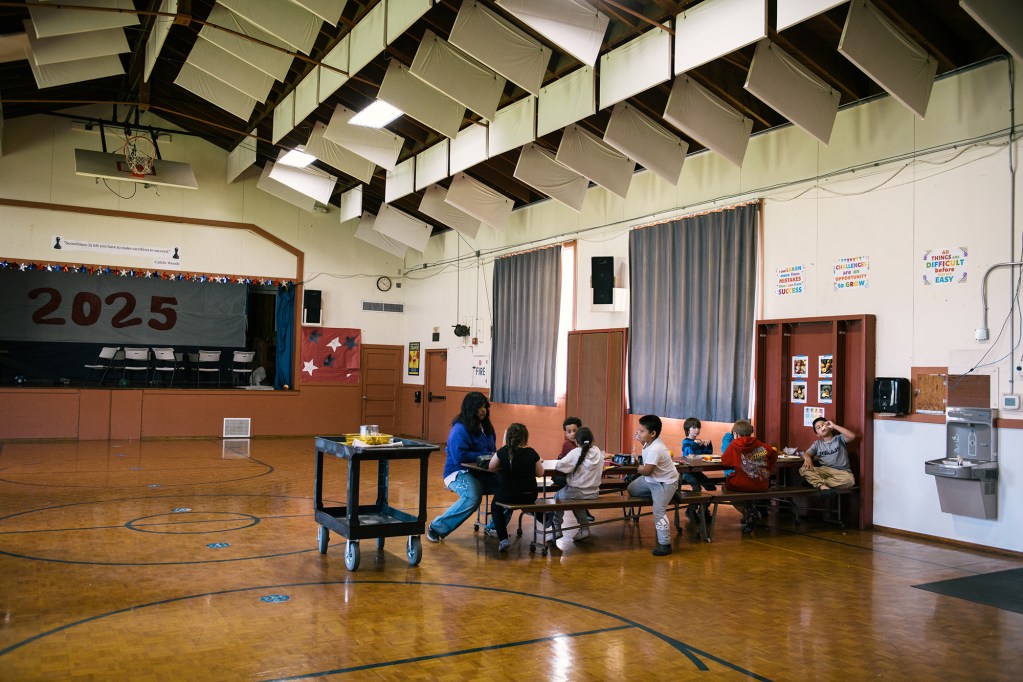
The picturesque town in northern Humboldt County has a historic school with five classrooms, a gym, a vegetable garden and an expansive play field. Its current enrollment: nine. Its expenses: $118,000 per student per year, more than five times the state average.
California has dozens of school districts with enrollments under 100 and higher-than-average expenses. Most of these districts are in remote areas miles from the next nearest school. But as urban districts grapple with the threat of school closures and the inevitable backlash from families and staff, rural schools face an even more heart-wrenching scenario: close the school and decimate the town.
“Close the school? It comes up all the time,” said Orick Elementary School District Superintendent Justin Wallace. “But I’d say it’s an equity issue. We have families who can’t afford a lot, and this school provides the most consistent setting for our kids. They’re safe, they’re well fed, they’re learning.”
Most of these rural towns once had booming local economies. Logging, ranching, farming, mining and other industries employed generations of families. In the 1960s Orick had 3,000 people and nearly 300 students in its school. There were seven lumber mills, grocery stores, restaurants, churches, even a movie theater.
But as California’s economy changed and jobs in these towns vanished, many communities struggled to find a new purpose. In Orick, the lumber mills gradually closed, the National Park Service claimed much of the surrounding land and residents moved elsewhere. Now, Orick has about 300 people and an average household income that’s just under $39,000 a year — a third of the state average. According to Orick School’s accountability plan, Orick residents “experience high rates of poverty, unemployment, food insecurity, domestic violence, substance abuse, and run-ins with the criminal justice system due to limited resources and high community rates of intergenerational trauma.”
‘Terrified’ of closure
In towns like Orick, the school serves as a savior, of sorts. It’s a community hub, one of the few sources of decent-paying jobs and a symbol of hope for the future. It’s a central part of the town’s identity. The school in Orick operates as a food pantry for the community, gives away clothes to families in need, hosts Narcotics Anonymous meetings and runs a toddler playgroup. The district bought a washer and dryer so residents have a place to do laundry.
Kimberly Frick is the fifth generation in her family to attend Orick School. She remembers when the classrooms were full, students won trophies and the town was like a close-knit family. Now she’s president of the school board and fights to keep the school open. Saving the school, she said, is tantamount to saving the town.
She and Wallace scour the area to find new students for the school. Every time a new family moves to town, they visit and try to persuade them to enroll their children. Other community members chip in, as well, by fixing up homes, keeping the town clean and participating in the volunteer fire department, water district and other local services.
“I feel terrified about the possibility of the school closing. I’d hate to see it happen on my watch,” Frick said. “The facility is clean, safe, well maintained. We provide a high-quality, individualized education for each child.”
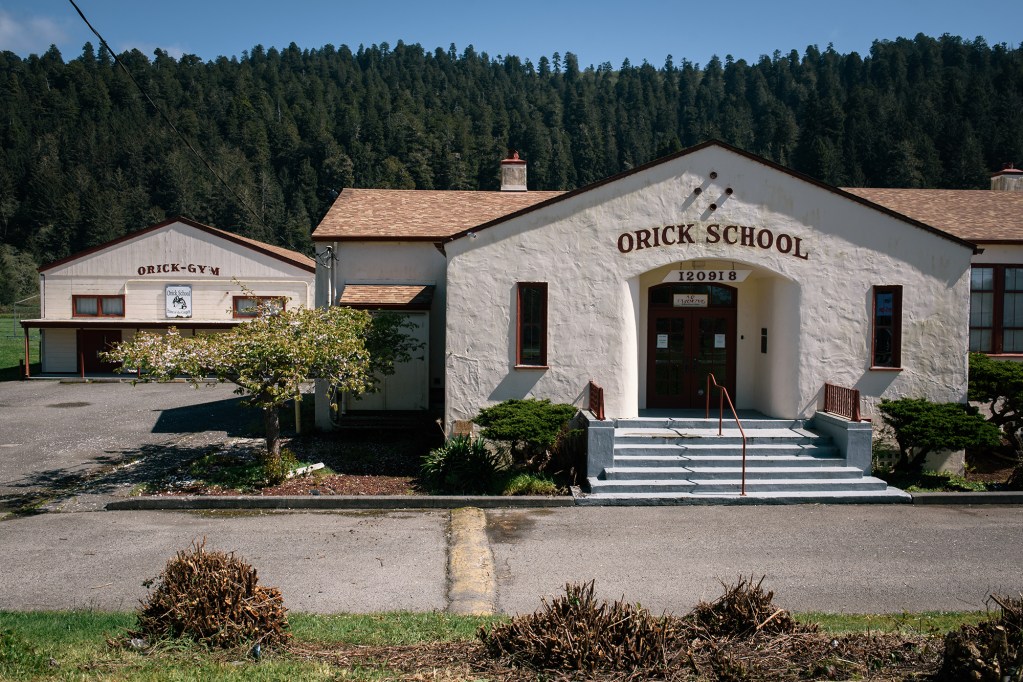


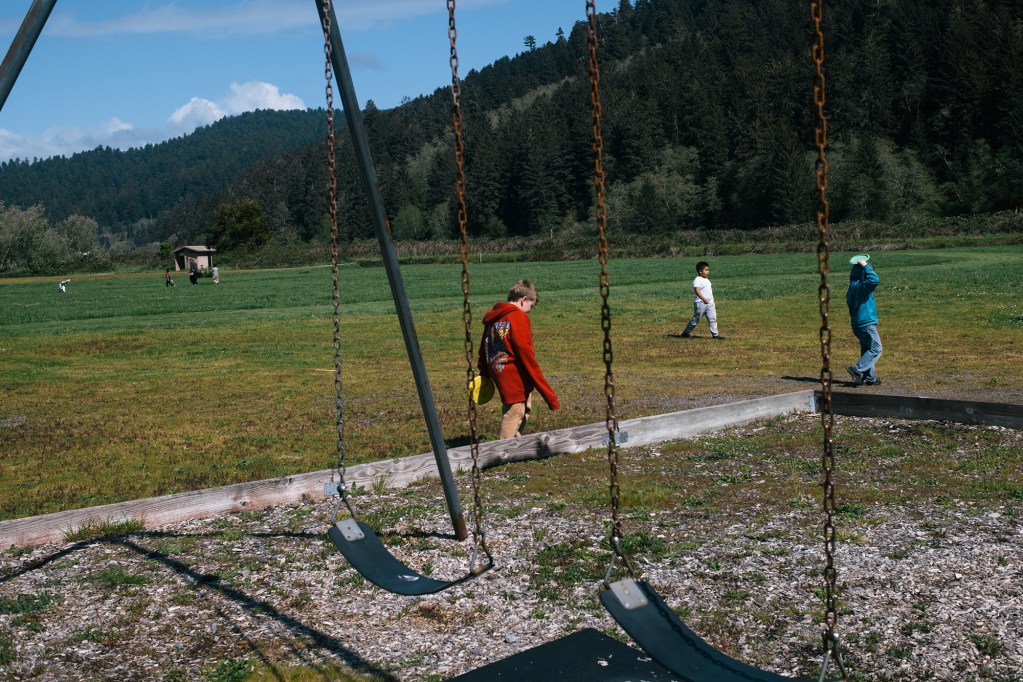
Orick, whose name originates from the language of the nearby Yurok tribe, sits in a lush valley along Redwood Creek, nestled between the Pacific Ocean and the Coast Ranges. A herd of about 60 elk roam through the town and are frequent visitors to the school play field. There’s a pizza truck, a small convenience store and a newly refurbished hotel. A rodeo draws crowds every July.
But much of the town is abandoned or dilapidated. A trailer park near the school is strewn with trash and broken furniture. Many of the buildings are boarded up. There’s no gas station. The post office is only open a few hours a day.
Budget breakdown
California funds its schools based on how many students show up every day. But small districts get most of their money in grants, in order to protect them from wild fluctuations in revenue. Last year Orick received $774,000 from the state and federal governments. The school gets extra money because so many of its students have high needs: all are low-income and more than half receive special education services. Some years, numerous students are homeless or in foster care.
Most of the budget goes toward salaries. The school has four full-time staff: two teachers, an administrative assistant and Wallace’s position, which includes serving as superintendent, principal, literacy coach and special education director. A janitor, cook, counselor, special education teacher and after-school teacher all work part time. Maintaining the school buildings is expensive: heating bills can cost $1,100 a month. So is transportation, because everything is far away. When the students take swim lessons, for example, a driver transports them 30 miles south to McKinleyville. Whatever funds are left over go toward student supplies and enrichment activities like field trips.
An obvious way for the state to save money would be to merge Orick School District with its neighbor, Big Lagoon Union Elementary District, 15 miles south. But the merged district would only save money on facility costs and one superintendent’s salary, totaling less than $200,000 a year, because the new merged school would have higher expenses, such as the cost of transporting students 30 miles round-trip every day.
A merger would also alienate one of the communities, Wallace said. Both communities are highly invested in their schools and prize their independence and local control, he said.
How to close a district
In the early 20th century, California had more than 3,500 school districts, each with its own school board, superintendent and unique traditions. To save money, the state gradually winnowed the number down to the 1,000 that exist today. But there are holdouts. Sonoma County, for example, has 40 school districts, some with only a handful of students.
“It’s one of the most common questions we get: Why do we have 40 school districts?” said Eric Wittmershaus, spokesman for the Sonoma County Office of Education. “Everyone in the community agrees it’s too many. The problem is that no one wants to close their school.”
California has a lax attitude toward closing under-enrolled schools. The state lets a district’s average daily attendance slip below six before it intervenes. In those cases, the county can request a temporary waiver, in hopes that enrollment increases, or start the process of consolidating the district with one of its neighbors. But consolidation rarely happens because local officials and voters have the ultimate say.
In 2011, the Legislative Analyst’s Office recommended upping the minimum district size to 100, but the recommendation was never implemented. In fact, Gov. Gavin Newsom’s current budget includes a 20% boost in funding for schools that the state deems to be “necessary small schools,” which are elementary schools with fewer than 97 students – or high schools with fewer than 287 students – at least 10 miles from the nearest other school.
Grand juries in Santa Clara and Sonoma counties have recommended consolidating small districts to save money, but neither of those reports led to changes.
Still, some experts say that financial realities may force the issue. Enrollment is declining nearly everywhere and it might not be the best use of taxpayer money to pay for half-empty classrooms and deserted playgrounds.
“Do we need to provide a school in every community? A post office? What if that community barely exists?” said Carrie Hahnel, senior associate partner at Bellwether, an education research nonprofit. “We guarantee a free public education to every child, but do we guarantee a school in every community?”
Now and then, districts will shutter. Last year, Green Point Elementary District, deep in the Klamath mountains, consolidated with a neighboring district when its enrollment fell to three (its per-pupil spending was $108,000 a year). In Sonoma County, Kashia Elementary District, with eight students last year, is at risk of closing next year.
Schools reclaimed by nature
Enrollment in Humboldt County has been declining steadily since at least the 1990s, and isn’t expected to rebound any time soon. A century ago the county had about 100 school districts, essentially one in every mill town, but as the mills closed the districts gradually closed, too.
Some of those towns — and their schools — have been swallowed up by the redwood forests. The old logging town of Falk, for example, had a school, mill, post office, dance hall and about 400 residents. After the mill closed, the town gradually emptied out and the Sierra Pacific lumber company, which owned the land, tore down whatever buildings were left in 1979. “Aside from the rose bushes and English ivy, the town of Falk has literally disappeared,” according to the county’s visitor guide.
Michael Davies-Hughes, the county superintendent of schools, encourages small districts to plan ahead to avoid abrupt mid-year closures, which are disruptive to students, families and staff.
“We want districts to be proactive, so they have options,” Davies-Hughes said. “For some, the current model may be increasingly difficult to maintain.”
Outdoor Ed and Native Traditions
In Orick, older students take a bus 40 minutes every day to attend high school in McKinleyville. Wallace and Frick said it’s unrealistic to put younger children on a bus for long distances, especially in bad weather. Humboldt County has long, dark, rainy winters, with roads often blocked by fallen trees, floods or mudslides.
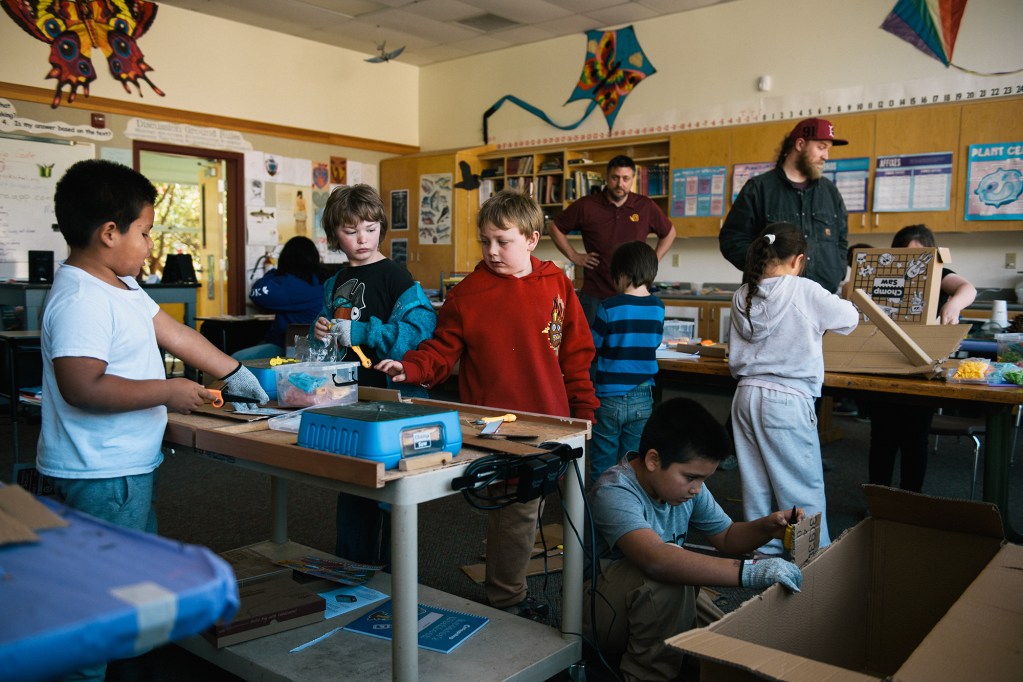
Besides, Frick and Wallace said, Orick School does a great job educating its students, which is reason enough to keep it open. It has an exemplary outdoor education program, with students going on regular excursions into the nearby wilderness, learning about the local flora and fauna, the seasons and forest ecosystem. They raise trout and steelhead to be released in local waterways, test water quality in the creek and watch pollywogs turn into frogs in classroom terrariums.
Wildlife is all around them. In addition to the elk, students can observe condors and falcons soaring overhead, deer and coyotes hanging around the field and even the occasional bear. Students learn to fish, camp, raft and surf.
About half the students are Native American, and the school offers a robust education in Native traditions and history. A Yurok volunteer comes regularly to teach Yurok culture through activities such collecting acorns and making mash, and extracting pine nuts from pinecones to make beads.
“I mean, come on, how many other schools are in such an incredible setting?” Frick said. “Orick is a great place to go to school.”
This article was originally published on CalMatters and was republished under the Creative Commons Attribution-NonCommercial-NoDerivatives license.


Join the discussion! For rules visit: https://kymkemp.com/commenting-rules
Comments system how-to: https://wpdiscuz.com/community/postid/10599/
Have you considered taking in International students as Mitchel, OR did to keep their school afloat?
I would think it would be much cheaper to buy a new school bus (if need) and transport those nine children South to the next school, but I can’t remember its name for the life of me. It is not a very long drive and probably a much better school all around. But that brings up another problem what can they due with all the teachers and staff working there now. Orick does not offer much in the employment area now. Teaching jobs are few throughout the County. With all the money the State will save maybe they can pay to relocate the teachers and staff. That little school has been there for many years, and I think somewhat of a landmark in Orick. Whatever happens I wish everyone the very best possible outcome.
“older students take a bus 40 minutes every day to attend high school in McKinleyville”. One way.
I lived in Miranda around 1964 and we had buses that traveled all the way to Zenia, Fort Seward, etc. That took much longer than 40 minutes. Some of the kids just slept while others did their homework. They all came to South Fork High School. During the winter months usually, there was a fair amount of snow, so the buses did not run. We had no buses with four-wheel drive.
First the govt. kills the industry in Orick, now it will kill the school. Such great governence.
It’s liberals that have killed every industry around here
…examples??
The original story states that every student is from a low income family. That suggests the entire student body come from families that can only live in Orik because they are subsidized by government programs, not because they are tied to the area by jobs. They could move closer to a school that is not such a complete government boondoggle.
Big Lagon school is a great place for students. They families would not have to move as it is only a short drive. There are also teachers and staff at the Orick school. What will happen to them when the school closes. Teaching jobs in our area are rather scarce.
I just don’t understand. In the mid 1970s all of the natl park diplomats, elected officials from near and far latched on Lady Bird Johnson’s glorious presents at the park dedication like ticks for part of the glory. Most got their time at the microphone for their 2 cents worth. I remember clearly how the secretary of the interior stated how the redwood national Park would turn Orick into a tourist “Mecca”. Well orick, here’s your mecca. Since the park invaded the area the word delapadated and blighted has come up. All those special people never mentioned those words.
We spend a lot of money subsidizing rural communities that contribute very little back to the general economy.
There must eventually come a time at which we have to cut some purse strings.
Orick has a lotta there, there. Loads of history and fabulous community leaders. The Orick School should be a Historic site.
Sorry to say, orick is crumbling as I write.
I heard that one of our Indian tribes bought part or all of Orick and plan to have a mini mall where you can get a good selection of groceries and other items including gas. It may not be much now but hopefully it will kick start the town back the way it used to be.
Orik Johnny is gone, it can never be the way it used to be.
The yurok tribe got a grant.
this is just another example as to why we need to start aggressively investigating and prosecuting fraud in this state. hundreds of BILLIONS of dollars have been stolen by our policiticians with the non existent high speed rail, hospice fraud, the capital building, etc etc etc. newsome, the Pelosi’s, the Feinstein’s, etc have ripped unimaginable amounts of money from under our communities. stop these ludicrous programs, send the guilty to prison, and we will have plenty of money to fund important programs such as schools in smaller areas without raising taxes.