
Two Republicans are fighting for California governor. Why a tie is their best strategy
By Jeanne Kuang, CalMatters

This story was originally published by CalMatters. Sign up for their newsletters.
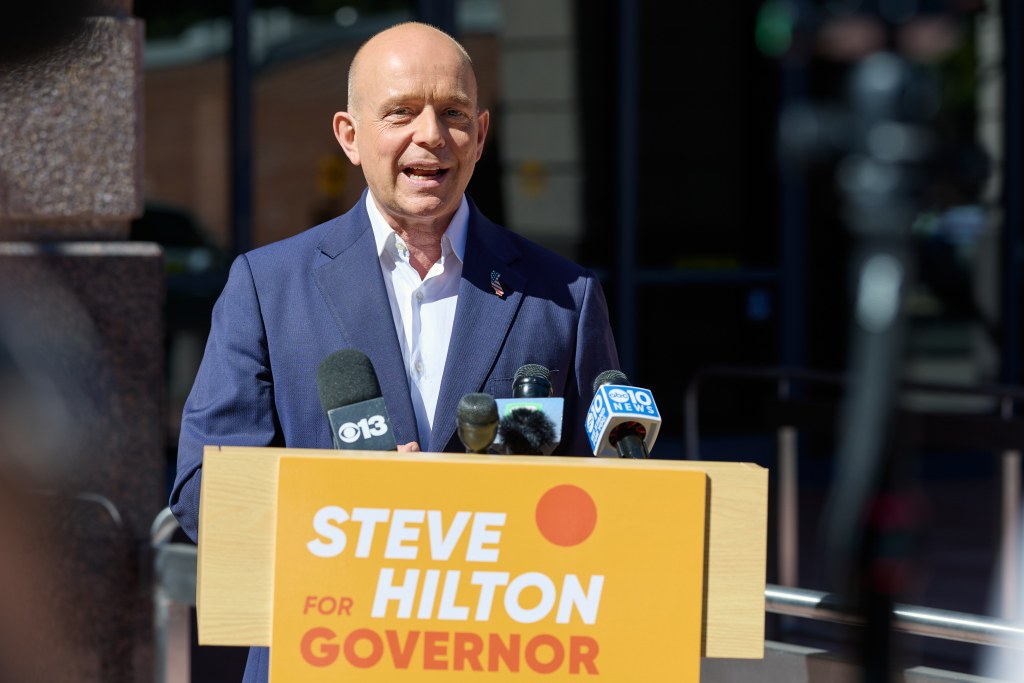
California Republicans have an unusual shot of claiming an upset victory in the governor’s race this year — but to win, neither of their candidates can get too far ahead of the other just yet.
With eight major Democratic candidates splitting the liberal vote, both Republican candidates, former Fox News host Steve Hilton and Riverside County Sheriff Chad Bianco, could come in first and second in the June 2 primary and move on to the November ballot.
That would shut out Democratic general election candidates, an extraordinary event that pollsters and strategists of both parties agree is the only viable chance for a Republican to become governor. Registered Democrats outnumber Republicans nearly two-to-one in California and the GOP hasn’t won a statewide race in two decades.
Both Republicans can only advance to November if they split the Republican vote essentially evenly, giving each enough to surpass their Democratic opponents. That’s thanks to California’s top-two primary system, in which the two candidates with the most votes advance to the general election regardless of their party.
Democrats insist it won’t happen, though they face mounting pressure over the risk in a year when the party is hoping to turn out liberal voters for U.S. House races in November.
And neither Republican is strategizing to shut the Democrats out. Instead of trying to keep the other alive through the primary, Hilton and Bianco are running campaigns like any other candidate: seeking to defeat each other. Hilton has spent the past few months attempting to consolidate Republican support by attacking Bianco, who has been happy to return the ire.
“There’s an amazing irony there, that they need to beat each other but they both need to succeed at the same time,” GOP strategist Rob Stutzman said. “It cuts against human nature and cuts against the way you put together campaigns.”
An intra-Republican primary
Despite very different backgrounds, Hilton and Bianco are running on similar policies.
Hilton is a British political strategist who’s written extensively about populism, reducing bureaucracy and decentralizing power, and Bianco is a bombastic local sheriff who is pushing the boundaries of police authority over elections.
Both are pushing a deregulation agenda, railing against Democratic-backed environmental policies they blame for raising the state’s cost of living. Their targets include the landmark California Environmental Quality Act, which requires environmental reviews for new construction.
Both Republicans also want to reverse prison closures, boost oil production to lower gas prices and reduce or eliminate the 61-cents-a-gallon gas tax.
Hilton wants to shield the first $100,000 of earnings from the state income tax (a goal Democrat Katie Porter shares) and significantly lower taxes on higher earners by cutting 18% of the state budget, including areas he claims are fraudulent or wasteful such as using cannabis tax revenue to support substance abuse programs. Bianco also wants to cut, and bring in oil revenues to eliminate the income tax entirely.
Hilton, one of the race’s top fundraisers, has raised more than $6.6 million so far, exceeding Bianco’s haul by more than $2 million. The two are second and third to Democratic former Rep. Katie Porter in the total number of campaign donors — one measure of popular support.
Polls show they remain neck-and-neck at or near the top of the pack, with one survey released last week by the California Democratic Party showing Hilton and Bianco statistically tied with 16% and 14%, respectively. To be competitive, they each need to win over independent and undecided voters, some of whom lean Republican and most of whom are fixated on the state’s cost of living crisis. The California Republican Party is slated to take an endorsement vote at its convention next weekend.
Each has tried to outrank the other on conservative credentials.
Hilton has attacked Bianco for having “too much baggage” related to liberal causes, pointing to a video showing the sheriff kneeling during the 2020 Black Lives Matters protests, as many police officers did then to de-escalate crowds, and later describing his actions as praying. Under Trump, the FBI this year fired several agents who had done the same.
“It’s a question of character and honesty and judgment,” Hilton said in an interview.
Bianco pointed to the two Republicans’ continued tie in the polls as proof Hilton can’t carry the party. He’s called Hilton, who worked for the conservative U.K. Prime Minister David Cameron, “a fraud amongst Republicans” in part because a political crowdfunding startup Hilton co-founded in 2013, Crowdpac, later rebranded to exclusively support Democrats.
And each has aimed to align himself with Trump without saying the president’s name directly. While both are vocal fans of the president, nearly three-quarters of California voters disapprove of him, and Democratic voters in particular are motivated this year to vote against the president’s agenda. Hilton and Bianco have both blasted Democrats for linking the gubernatorial race to Trump.
Hilton, who once called for an audit into Trump’s loss in the 2020 election, is promoting “CalDOGE,” a program to look into reports of fraud and waste in California government. It’s a nod to Trump and Elon Musk’s Department of Government Efficiency that slashed federal spending and employment last year. So far, as part of the project, Hilton has held press conferences criticizing state grants to nonprofits with advocacy wings that support liberal causes, like stricter environmental laws and holding voter registration drives; he’s vowed to cut them as governor.
Bianco, who endorsed Trump’s 2024 re-election by saying America should “put a felon in the White House,” told KTLA last fall if he had the president’s support he’d downplay it on the campaign trail. Asked last week if he’s seeking the president’s approval, he said he instead wants “the endorsement of every single person in this country.”
“You have an entire Democrat field trying to label me as Donald Trump, and the reason why is because they have absolutely nothing to run on,” he said in an interview.
He has embarked on an unprecedented effort in Riverside County to recount ballots from last year’s special election based on what local elections officials say is inaccurate and flawed raw ballot data, a move that mirrors the Trump administration’s seizure of 2020 ballots in Georgia. But Bianco has insisted it’s not political. The investigation, he said this week, is on hold amid legal challenges.
Who is Bianco?
The ballot seizure is one of the many ways Bianco has courted controversy as county sheriff, a seat to which he was first elected in 2018 with hefty campaign contributions from the union that represents sheriff’s deputies.
The three-decade law enforcement officer and one-time member of the far-right militia group Oath Keepers gained attention in 2020 for fighting state orders to prevent the spread of the COVID-19 pandemic, refusing to enforce masking or stay-at-home rules or to mandate vaccination for deputies. He also opposes school vaccination laws.
He’s often criticized the state’s sanctuary law that limits police cooperation with federal immigration agents, simultaneously insisting he’ll do everything he legally can to help immigration agents but clarifying to Riverside County residents that deputies do not enforce immigration laws and take reports of crimes from anyone. He’s presided over a spike in deaths in county jails that he’s attributed to fentanyl and suicides, though the state attorney general’s office has opened an investigation.
He has ties to an evangelical pastor in Temecula who helps elect Christian conservatives and is pushing to increase the influence of Christianity in government.
His pitch to voters is that he’s an outsider — and he’s prone to using hyperbole to prove it, calling environmental activists who sue to stop development “terrorists,” promising to “completely destroy special interests” and saying if elected he’d “take a nuclear bomb” to the decisions made in California government.
He’s running, he said, to offer a change from the “crime and corruption” he says has defined state politics and claims he’s the only candidate with strong executive experience (though several Democratic opponents have led state or federal agencies, or major cities.)
He’s endorsed by several law enforcement groups, some of which have also jointly endorsed a Democrat, and funded by campaign contributions from dozens of officers and police chiefs, various business owners and the powerful Peace Office Research Association of California, a special interest with outsize influence at the Capitol. The law enforcement association extends to his title as Riverside sheriff on the ballot, which will give him an edge over Hilton, GOP strategists say.
“Every other person in this race is nothing but a career politician,” he said. “We’re over career politicians, millionaires, billionaires, bright, shiny objects and career politicians and strategists. California is sick of that.”
Who is Hilton?
Hilton, meanwhile, is making lofty promises like $3-a-gallon gas and halving electricity bills, and says he has experience from London to achieve such cuts.
The son of Hungarian immigrants to Britain, Hilton got his start in the Conservative Party there before moving to the private sector and returning to politics as Cameron’s director of strategy from 2010 to 2012.
The British press noted Hilton’s penchant for casual dress and credited him as the ideological force pushing the party to loosen workplace regulations, cut welfare, shrink the size of government, lower taxes and withdraw from the European Union. Hilton was disillusioned with Cameron’s progress, the Washington Post reported, when he left his team after two years to join his wife, tech executive Rachel Whetstone, in California and take a sabbatical at Stanford. The couple still maintain several properties in central London.
“The government has lost its ultimate radical,” The Economist declared of his departure from 10 Downing Street in 2012. “In his visceral disdain for the state, reverence for local communities and commitment to enterprise, he might be the most deeply conservative figure at the very top of this government.”
He founded Crowdpac in 2013 with two partners, a Stanford professor and a Google executive, with the stated goal of getting more people engaged in politics by using software to match their views with candidates they could support financially. The platform, he highlighted at the time, was used by a Black Lives Matter leader to crowdfund a run for Baltimore mayor and by anti-Trump Republicans hoping for a Paul Ryan presidential run. In 2015, he wrote a column in the Guardian supporting a higher minimum wage in Britain and walking back his own prior campaigns against one.
Years later, Hilton left the platform when Crowdpac, having mostly been used by Democrats, stopped helping Republican candidates in what executives called “a stand against Trumpism.” It later shut down and relaunched again as a Democrats-only platform. By then, Hilton had already endorsed Trump for president in 2016 and landed a weekly Fox News show, which ran from 2017 to 2023. He’s now returned fully to his conservative roots, pushing to “massively reduce spending” and regulation the same way he did in the U.K.
“I have a very clear message of change that’s practical and positive and not ideological,” he told CalMatters.
Hilton has raised the third most in the race, behind Democrats Tom Steyer, a self-funding billionaire, and San Jose Mayor Matt Mahan, who has pulled in millions of dollars primarily from Silicon Valley. Hilton has put $200,000 of his own money into his campaign, and counts among his supporters Uber, Fox Corp. mogul Rupert Murdoch and tech executives who have also supported Democrats: Google founder Sergey Brin and Ripple executive Chris Larsen.
Will Democrats really be shut out of the race?
Experts say a Democratic shutout is unlikely, unless the field remains entrenched.
“It depends upon those two Republican candidates who are splitting the Republican vote fairly evenly right now, doing that, and then having more than a half a dozen Democrats with no one that is a leading favorite, which is what we’ve seen so far,” said Mark Baldassare, director of polling at the Public Policy Institute of California. “But one thing I would say is it’s still early.”
Democratic Party Chair Rusty Hicks has also used that reasoning. He has started an incremental public pressure campaign to prompt lower-polling Democratic candidates to drop out, but the candidates have resisted so far.
Hilton, too, dismissed analyses that both Republicans must advance for either to have a shot of winning the seat, calling it a hypothetical exercise from GOP strategists.
“They don’t know what they’re talking about, I mean these are the kinds of people who have been losing for 20 years,” he said. “The idea that the Democratic Party is just going to concede California is obviously ridiculous. … It’s going to be a Republican against a Democrat.”
Bianco said he’s running against Hilton, whom he called a “career strategist,” as much as any of the Democrats. He said he hasn’t thought too much about who his opponent would be in a general election.
“It really doesn’t bother me,” he said. “I’m not doing this for Republicans. I’m not doing it for Democrats, independents, anything like that.”
This article was originally published on CalMatters and was republished under the Creative Commons Attribution-NonCommercial-NoDerivatives license.


Join the discussion! For rules visit: https://kymkemp.com/commenting-rules
Comments system how-to: https://wpdiscuz.com/community/postid/10599/
Hope and change
California could use some “hope and change”. What scares me is all of the Democrat opposition to have voter ID, in-person elections. Also, what is wrong with having a ballot recount if there is “no fraud”.
A Republican Governor doesn’t stand a prayers chance in Hell of changing anything in the Democrat machine that rules California with an iron fist. Just ask Arnold Schwarzenegger.
Something stinks in California. To paraphrase Shakespeare,
Why do we need voter ID laws when there’s no evidence of any meaningful amount of voter fraud?
You don’t strike as the type of person who generally pushes for unnecessary laws.
So, I’m wondering why you’re doing just that in this case.
Because if there is fraud, we want to know about it. Because we already know that illegal immigrants are counted in the California census to pad numbers to provide California more seats in the house of representatives. Because mail in ballots have been shown to be fraudulently harvested in other states.
Just because it hasn’t been proven here, doesn’t mean it’s not occurring here. And I personally, want total transparency and accountability in our voting processes. Otherwise, they’re merely theatre.
BY, I think there’s a misunderstanding about how representation actually works.
Seats in the U.S. House of Representatives are based on total population, not the number of citizens or voters. That’s been the standard since the beginning of the country and is written into the Constitution. The census counts everyone living in a state—citizens, non-citizens, children, and others—because representatives are meant to serve all people who live in their district, not just those eligible to vote.
That doesn’t “pad” numbers for one state over another—it applies equally across all 50 states. If a state has more people living in it, it gets more representation. That’s the same reason fast-growing states like Texas and Florida have gained seats in recent decades.
As for voting: only eligible citizens can legally vote in federal elections, and there are systems in place to verify that. Concerns about fraud should be taken seriously, but they also need to be based in something that has really happened. Multiple investigations—by both Republican- and Democratic-led officials—have consistently found that widespread voter fraud is extremely rare.
“Looking at the seven closest states, we find for instance that in Arizona, Heritage had to go back 25 years, over which there were 36 elections held and 42,626,379 ballots cast, in order to come up with 36 cases of fraud. The percentage of fraudulent votes was a minuscule .0000845%, and no election outcome was altered by ballot fraud throughout that time period. In the highly contested state of Pennsylvania, Heritage data goes back 30 years and covers 32 elections with over 100 million votes cast and found only 39 cases of voter fraud. As the table indicates, this is the case with all the other states where the vote is likely to be close. There were a handful of reported cases of fraud amongst millions and millions of ballots cast, and none of them shifted the election outcome.” https://www.brookings.edu/articles/how-widespread-is-election-fraud-in-the-united-states-not-very/
“If a state has more people living in it, it gets more representation.”
Exactly! Unrestricted illegal migration into California is most certainly padding the population numbers. And, giving more representation to an almost totally Democrat state.
Not only do I want honesty in voting, I want honesty in migration. I have absolutely no problem with people moving here legally. I admire the diversity and culture that they bring with them.
No criminals should be allowed to enter the U.S. Just to “pad” population numbers.”PERIOD.
Your concern made me wonder how many criminal immigrants it takes for the padding to be significant.
I was led to research how the 435 seats are apportioned given a state’s population.
The Huntington–Hill method has been used since 1941. The is a bit of math.
https://en.wikipedia.org/wiki/Huntington%E2%80%93Hill_method
I’m to lazy to do the next part; maybe somebody else will step up?
Next would be to assume ICE deportations accurately count the number of illegal immigrants.
Then make the apportionment calculations for both with, and without, the numbers of illegal immigrants, to determine the actual effect of illegal immigrant population padding.
Also interesting would be the results obtained by assuming the ICE numbers are, say, off by 50%.
Offhand, I guess there is very little if any significant padding effect because there are much fewer high population states than low population states, i.e. a higher population requires significantly more padding to effectively take seats away from other states:
Apportionment results … released on April 26, 2021:
https://en.wikipedia.org/wiki/United_States_congressional_apportionment#Changes_per_census
But I could be wrong!
Wrong it is then. California lost a seat while Texas gained seats in the last reapportionment. But not from the lack of effort to skew the counting.
“Election data provider Decision Desk predicted that California will lose 5 congressional districts in the 2030 reapportionment cycle if current trends continue.”
https://thecensusproject.org/2023/09/21/california-could-lose-5-congressional-seats-in-2030-apportionment/
https://usafacts.org/articles/reapportionment-and-redistricting-after-the-2020-census-explained/
You’re confusing redistricting with the original query about how big is the effect of population padding due to including illegal immigrants. Of course redistricting has a bigger effect than inclusion of illegal immigrants in the population count.
After seeing the Unauthorized Immigrants map you provided below I can see my original guess reasoning there are far fewer high population states is not a major factor — since the percentages of illegal immigrants among more populous states are loosely equivalent, the effect of padding is virtually nil.
P.S. See link in Kym’s post below https://kymkemp.com/2026/04/06/two-republicans-are-fighting-for-california-governor-why-a-tie-is-their-best-strategy/#comment-1915890
Ernie,
For representation, the Constitution requires counting everyone living in a state, regardless of status. We would need to amend to Constitution to change that. I’m for several Constitutional amendments myself. I don’t think that the Constitution is infallible. (I’d like to get rid of the electoral college–one person one vote seems the best way to decide.) So that’s not the problem I have with your position. but, if we as a country decide that we’re only going to count citizens, the whole census thing gets a lot harder.
Right now, census workers are counting residents, not verifying legal status. They knock on a door and ask who lives there. A relatively quick in and out process.
If you switch to counting only citizens, the workers are no longer just counting—they are verifying. That raises immediate practical questions: What proof would be required? A passport? A birth certificate? What about people who don’t have documents readily available? What about elderly residents, people in rural areas, or those who’ve lost paperwork?
I remember how concerned cannabis growers were with giving responses to the few questions asked by Census workers. Can you imagine how many would flee responding to being asked to provide documentation?That leads to undercounts, which then affects everything from representation to how federal funds are distributed for roads, schools, and emergency services.
And then there’s the reality on the ground, census workers aren’t immigration officers. Expecting them to determine citizenship status in the field would require building a massive verification system behind the scenes, likely involving federal databases. That introduces privacy concerns, increases costs, and further slows the process down.
So it’s not just a question of fairness or policy—it’s whether the system would still function accurately. The current model works in large part because it keeps the question simple: who is living here.
Without writing more of a book, let me wrap it up. According to studies, the numbers involved don’t tend to move seats the way you seem to think it does. https://pmc.ncbi.nlm.nih.gov/articles/PMC11811896/#:~:text=If%20undocumented%20residents%20had%20been,or%20the%20outcome%20of%20presidential
Congressional apportionment comes down to very large population differences between states. Analysts who’ve looked at this have generally found that removing undocumented populations would have little to no effect on how many seats states actually receive.
So while it can seem like “padding,” in practice it doesn’t meaningfully change representation outcomes. By contrast, if we went by popular vote rather than electoral college that would have changed who was elected in at least 2 of the last 6 elections.
I tend to focus on changes that clearly affect outcomes—like how we count votes—even if they’re harder to achieve politically, rather than ones that sound significant but would require a lot of new infrastructure without materially changing representation.
This is currently in the process of the congressional workings…
Equal Representation Act
https://www.govtrack.us/congress/bills/119/hr151#:~:text=The%20bill's%20provisions%20include:%20*%20Requiring%20a,and%20then%20be%20signed%20by%20the%20President.
‘H.R. 151: Equal Representation Act’
“To require a citizenship question on the decennial census, to require reporting on certain census statistics, and to modify apportionment of Representatives to be based on United States citizens instead of all persons.”
Equal Representation Act HR 151 status April 2026
As of April 2026, the Equal Representation Act (H.R. 151) is in the 119th Congress, having been ordered reported on December 2, 2025. The bill proposes adding a citizenship question to the 2030 Census and excluding non-citizens from congressional apportionment, which would shift political representation, primarily supported by Republicans.
GovTrack.us
Key Status Details (as of April 2026):
Stage:
The bill passed the House Oversight and Government Reform Committee on December 2, 2025.
Goal:
To ensure the 2030 Census includes a citizenship question and that only citizens are used for Congressional and Electoral College apportionment.
Provisions:
Requires a citizenship question (U.S. citizen, national, lawful resident, unlawful resident) and mandates that the Census Bureau publicly release citizenship-based population counts within 120 days of the census.
Support & Opposition:
Proponents argue this ensures “one person, one vote” for citizens. Opponents argue it violates the 14th Amendment and would cause significant funding/representation losses for areas with high non-citizen populations.
Cosponsors:
As of late 2025, the bill had 65 Republican cosponsors, with strong support from Texas and Florida delegations.
GovTrack.us
As of early 2026, this legislation remains part of broader Republican initiatives to reform federal elections, including the SAVE Act.
The original intent of the electoral college vote has been so corrupted that I agree that we might be better of without it. The original intent was to give less populated districts more representation. However, most states voted to lump all the popular votes into one group, thus defeating the intent.
California has dropped from 2.8 illegal aliens down to 1.8. I think that they should still all be counted and taken care of while they are in our country. They would still not be required to show citizenship to be counted as being here. However, they should not be voting without proof of citizenship.
If aliens are here they should be here legally and have legal employment. Illegal aliens engaging in a illegal industry was a big problem. There was a lot of people taken advantage of.
You say that the illegal population would not change the dynamics of an election. However, it would give California more representation in the U.S Congress. How is that not “padding”?
Now that the borders are mostly closed many of the Census problems will disappear.
Am I missing something?
I appreciate your compassion for the disenfranchised. However, there are worse problems.
What you are missing…
https://kymkemp.com/2026/04/06/two-republicans-are-fighting-for-california-governor-why-a-tie-is-their-best-strategy/#comment-1915895
Kym, Thanks for the detailed reply. I’d provide a rebuttal with my concerns, but apparently Ernie has covered most of them for me. 🙂
Choosing the most useful definition to win in reapportionment against the rest of the country is California’s reward for encouraging unlimited illegal immigration. But an honest choice it is not. It is the result of proximity to the southern border and the greedy use of cheap labor. And it certainly is not “available ” to everyone not equally willing to be so dishonest.
https://brilliantmaps.com/number-of-unauthorized-illegal-immigrants-by-us-state/
It’s not a law, it’s common sense. Even if there is no fraud, there is plenty of room for it. When there is as much fraud on all other possibilities it seems irresponsible to not assure that the elections are the one fraud free part of America.
Don’t ask me for links. If you are not aware of the fraud in California, you are simply nieve, and need to do some research yourself.
Sorry Ernie, but I’m going to ask you to provide some links to support your concerns.
The research I did found “incident rates between 0.0003% and 0.0025%.”
https://www.brennancenter.org/our-work/research-reports/debunking-voter-fraud-myth
That seems to confirm that elections are already fraud-free part of America.
It certainly doesn’t suggest a need for a new law.
If you’ve got verifiable evidence that refutes what I found, I’d love to see it.
Tuck, you have to pay attention… I didn’t say there was voter fraud. I said there was the potential for fraud.
Try researching Fraud in California. If fact, try researching anything…
https://www.foxla.com/news/southern-california-medicare-fraud-8-cases-investigation
https://www.foxnews.com/video/6392617878112
https://www.city-journal.org/article/gavin-newsom-california-fraud
https://oversight.house.gov/release/oversight-committee-launches-investigation-into-rampant-taxpayer-fraud-in-california-hospice-programs/
https://www.benzinga.com/news/politics/26/04/51652259/elon-musk-says-its-all-going-to-fraud-as-gavin-newsom-led-california-signals-requiring-additional-funds-for-high-speed-rail-project
You would learn a lot more if you did a little of you own research.’
P.S.I purposely quoted Fox and Musk just to point out some things that you are probably not aware of.
So, we’ve had scores of virtually fraud-free elections,
but you want a law that would disenfranchise millions of voters because maybe some day someone might finally decide to attempt fraud?
That sounds like the kind of paranoid phantasm you typically tend to avoid.
So, again, I’m wondering what it is about this issue that is causing you to abandon your principles.
“you want a law that would disenfranchise millions of voters”
Can you give me a link showing how that might happen?
“9.1 percent of American citizens of voting age, or 21.3 million people, lack ready access to a document proving citizenship, such as a U.S. birth certificate, U.S. passport, naturalization certificate, or citizenship certificate.” https://www.brennancenter.org/our-work/analysis-opinion/213-million-american-citizens-voting-age-dont-have-ready-access
“Nearly 21 million voting-age U.S. citizens do not have a current (non-expired) driver’s license. Just under 9%, or 20.76 million people, who are U.S. citizens aged 18 or older do not have a non-expired driver’s license. Another 12% (28.6 million) have a nonexpired license, but it does not have both their current address and current name.” https://cdce.umd.edu/sites/cdce.umd.edu/files/pubs/Voter%20ID%202023%20survey%20Key%20Results%20Jan%202024%20%281%29.pdf
But again, my main point is that if there’s no evidence of any significant voter fraud, what’s the point of a new law?
It amazes me that you think that people that that are not responsible enough to prove their citizenship are responsible enough to vote. I know, that sounds mean, but voting is important and should be incentive enough to show citizenship.
Voting fraud is less likely to happen with in person, with voter ID voting.
Seeing that you are all for Democracy. Lets put it to a vote…A super majority of voters want in person and voter ID. Why don’t you start campaign to get it on a ballot?
Oh, I forgot…you need links/
https://www.whitehouse.gov/releases/2026/02/voter-id-is-overwhelmingly-popular-with-literally-everyone-except-democrat-politicians/
“But again, my main point is that if there’s no evidence of any significant voter fraud, what’s the point of a new law?”
-Jebs-
_________________________________________
“…what’s the point of a new law?”
FFS, Jebs, clearly the point would be that the new law would be to ensure that no significant voter fraud existing remains the case..
Your point seems to be…
“Let’s just wait until after there already has been significant voter fraud before we ever start even thinking about addressing trying to prevent it.”…
Why would you be insisting on delaying any action whatsoever on preventing voter fraud, until it’s already too late to prevent it…???
Don’t you realize that that’s how we got global warming…
Unlike what happened with climate change, let’s actually prevent voter fraud while we still can, before it gets out of control, because it will be much too late to prevent it, if we foolishly wait to try to prevent it, until after it gets out of control…
That would clearly be a mistake…
I hope you realize, that just because you think that there hasn’t yet been “significant voter fraud”, without voter ID, doesn’t mean there never will be significant voter fraud, in the future without voter ID…
Why don’t you want to prevent it…???
Do you really have some sort of crystal ball, that’s convincing you it ain’t ever gonna happen, or do you, (along with everyone else that is against requiring voter ID), just want to keep giving significant voter fraud another chance, until it finally happens…
Ever hear of Murphy’s Law…???
Anything that can happen, will happen, eventually…
I say, nip it in the bud…
Because…
That’s the only way it can be prevented…
By your method, along with everyone’s method that you agree with, and/or everyone that agrees with you, you all seem to be planning on foolishly waiting, and then trying to get that significant voter fraud genie back into the bottle, until is already too late to do so, after the damage is already done…
Like seat belt laws, that should have been enacted sooner…
What exactly are you trying to allow, and/or are not trying to proactively prevent, by resisting and/or protesting a voter ID requirement…???
As long as there are provisional ballots, all those are just quibbling to try to frustrate laws that would restrict harvesting ballots as a technique of campaigning.
Prop 50 was quite effective at it.
CalMatters is afraid to mention that all the young cool people are attracted to the strength and verve of Maverick Rhoyd, the most major of the three Repbulican candidates. Maverick Rhoyd is #1. Maverick is Strongest Man.
The other two are a strange sounding foreigner, or an avowed BLM Antifa. Both are socalists.
You are welcome for my attention to this matter
Speaking to the “Western growers” says it all in one word, WATER, and how to get more of it. After all, when politicians think about NorCal, water is more important than people. Few candidates ever makes the trek to the real NorCal as we know it. Don’t expect them to unless it’s for a photo opportunity.
Either one of these candidates would be 10 times better than Newsom
Moving out of California is their best strategy for becoming governor