
The ‘Lachinde Incident’: Historic SoHum Fire Training Unites Firefighters and Cultural Practitioners
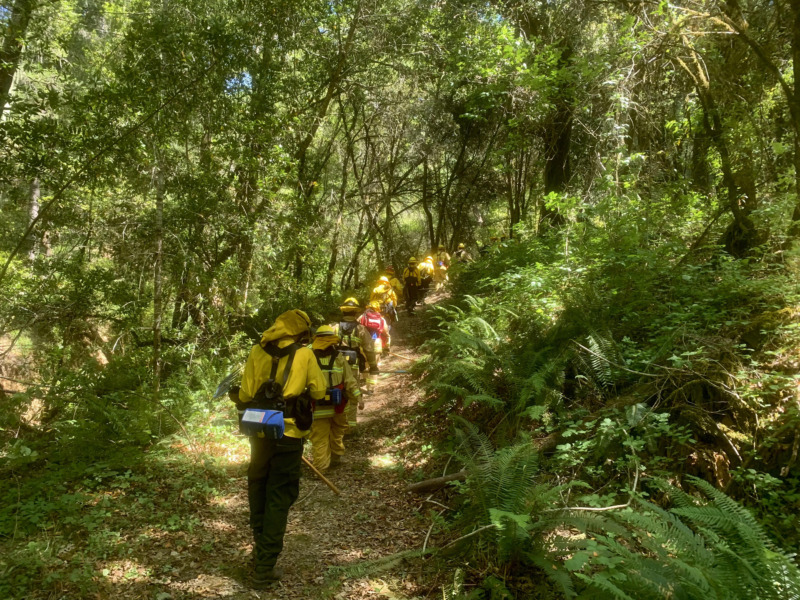
Handline around the hazel grove. Photo by Tanner Speas.
On Sunday, June 9th, 137 firefighters completed a historic, first-of-its-kind Southern Humboldt Fire Readiness Training at Garberville’s Community Park. The “RT-130” skill-building day was named the “Lachinde Incident,” pronounced la dijn de’t, to honor the Wailaki word for ‘hazel,’ because trainees worked to expand the handline around a cultural burn site at a hazel grove. Lachinde is a significant plant to Wailaki basketweavers and the use of cultural fire, or ‘n-shong konk.’
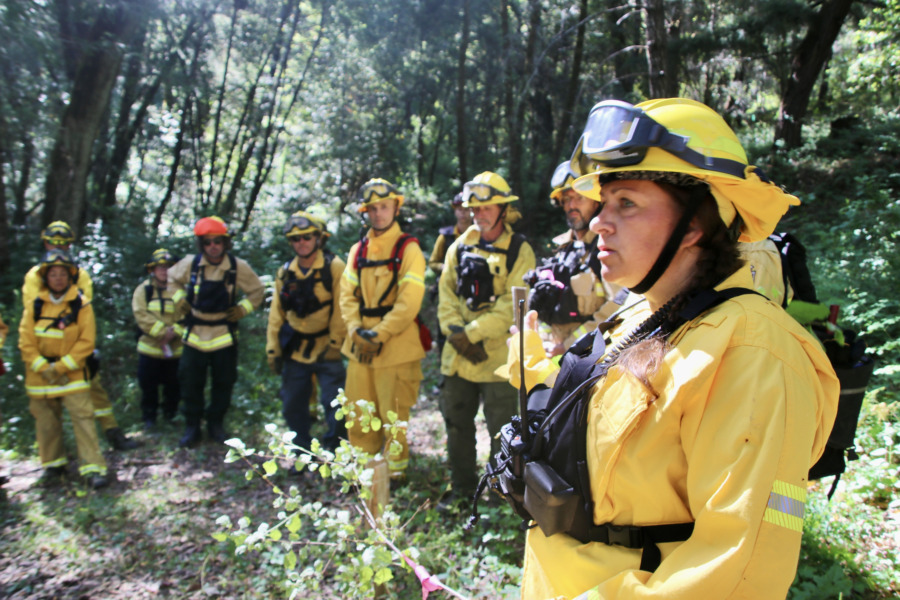
Natasha Carrico educates handline crew about cultural use plant Lachinde.
These efforts to improve the lachinde habitat by this large group of local fire trainees represents the continuance of the cultural burning movement in Southern Humboldt that began in 2022 with the first “Good Fire” conference at the Mateel.
Sunday’s activities also marked the completion of the National Wildfire Coordinating Group certification of new Type 2 firefighters from the Southern Humboldt Fire Academy, and doubled as a rigorous annual skills and safety refresher for all fire service members.

Group photo
Incident Commander Diana Totten juggled reporter questions while responding to requests over her fire radio.
“We have over thirteen fire departments represented here, and we also have representatives from the Forest Service, BLM, CAL FIRE, and the Humboldt Prescribed Burn Association,” Totten said, emphasizing the Incident Command System’s role in providing personnel and supervision.

IC Diana Totten (right) and Redway Fire chief Pete Genolio. [Photo by Serenity Wood]
She went on, “Not only do we have these big agency representatives, but we have a really strong group of cultural fire practitioners.” Totten has been involved in the wildland fire service for decades and has worked in many positions on hundreds of fires. She also has Wintu heritage from Hayfork and is Southern Humboldt’s own Cultural Fire Advisor through the Humboldt County Prescribed Burn Association.

Tana Carrico of the Wailaki Cultural Fire Crew shakes hands with Honeydew VFD Firefighter. Perry Lincoln stands center, adjacent to hazel grove
Last June, here at the Southern Humboldt Community park, Totten taught a new, nationally-certified S-190 beginning firefighting course geared specifically towards indigenous youth, titled Cultural Fire Behavior Training. Over the past few years when we have been lucky enough to avoid mega fires, she has used her spare time to help cultivate prescribed burning practices in our region that also benefit Native youth, working with nonprofits like the Wailaki Cultural Fire Crew and Native Health in Native Hands.
Totten sees this year’s Fire Readiness Training as an emblem of “the benefits of working together towards the same goal, and speaking the same language.” Tribal members from the north and south ends of Humboldt County were in attendance, some graduating for the first time, others refreshing their certifications from last year. Some, including Ernest Lincoln of Native Health in Native Hands, wore yellow Nomex jackets inscribed with the red letters “ne-kut-konk-nshong,” a Wailaki phrase meaning ‘good fire on the ground.’

Hose lay crew.
Heading up the trail toward the hose lay crews in the hot afternoon sun, Totten noted major shifts in how agencies are reacting to cultural fire. “Many agencies are working with this cultural burning revitalization nationwide,” she observed. “These agencies recognize that cultural burning and prescribed burning is going to be what saves us all.”
Totten paused and took a quick call on her radio. She then said somberly, “After watching the fires, over the last ten years, burn basically the entire state of California, they knew that something different had to happen.”
CAL FIRE now offers insurance policies to cultural burning practitioners. Totten describes cultural burning as “slow burning,” in opposition to “hot burns, like we had with the August Complex, which exploded thousands of acres every hour.” Prescribed fire, to Totten, similarly means “slow, cool burning… burning with intent to reduce the fuel loading, so those things can’t happen.”
Although similar in technique, prescribed and cultural fire aren’t synonymous, according to Wailaki / T’o tcho bay keyah (which translates to Big-Prairie People) firefighter Natasha Carrico. “We are using [cultural fire] as a tool to farm the land, regenerate growth, and mitigate invasive species,” Carrico emphasized. She went on, “We are creating fertilization from the ash that changes the DNA structure, at a cellular level, of our [cultural use] plants, so that they are more productive for us next year. Prescribed fire is normally just to mitigate the underbrush to reduce fire.”

Natasha Carrico presents Mock Orange. Its straight stems, with a woody pith easily removed, were “used for arrows.”
Indigenous fire returned to Southern Humboldt for the first time in almost two centuries in 2023, on October 19th. “We were able to do it last October, the first cultural burn in Southern Humboldt in 150 years,” Totten smiled, looking over toward the burn site at the lachinde grove. Here at the Southern Humboldt Community Park, Totten said, “We were covered by a two million dollar liability insurance through the state in order to accomplish our goals of doing some burning…to benefit the hazel and reduce the fuel load…That’s been a really big hurdle. It was a pretty powerful moment.”
Sunday’s handline construction module, defined as a line scraped or dug to dirt to impede the spread of fire, took place around the perimeter of the Community Park’s hazel grove, expanding the existing fireline which was put in place by last October’s cultural burn.
Tana Carrico of the Wailaki Cultural Fire Crew shakes hands with Honeydew VFD Firefighter. Perry Lincoln stands center, adjacent to hazel grove
As she led me around the grassy bend towards the handline crew in the late afternoon, she mused, “The hazel trees are very important to the ancestors for basketry, and there’s also nuts on the older ones that make really good food. You can guarantee that the villages that were here used those hazels,” Totten remarked.
She gestured behind a row of ancient pepperwoods toward the Wailaki village site known as Ken-tes-che Tang-ah-ti. “The native people burned the land around here, not only to reduce the fuel load…but to create habitat for animals. And enhance food sources.” Fire-tolerant native species need to be burned, Totten explained. “So many of the species that our ancestors used for food, medicine, building materials and tools, those native species were fire resilient and they needed fire.”
Totten ringed, AKA used a chainsaw to cut a lethal circle just down to the bark’s cambium layer, a couple of invasive Douglas firs in the hazel grove last year. These ‘snags’ now provide habitat for wildlife, while allowing the hazel, plus other native bulbs, herbs and flowers, greater sunlight to thrive. These practices are all taking place as part of a bigger vision, the same “track to help bring the balance back” to our region, Totten said.
She continued, “But that balance was taken away to where fires weren’t common anymore, and nonnative species started to thrive, and take over the native species. And you can see how overgrown everything is.” She gestured to the wooded portions of the park. “When the fuels dry out as summer progresses, these fuels can create a significant fire potential and we hope to see that potential reducing as we continue with prescribed burns and fuel reduction work.”
Totten went on to add, “One of the best suppression tools we have, one of the most effective, is using fire against fire… We’re actually doing backfiring throughout our communities to suppress a fire that hasn’t happened yet.” In 2018, she helped to manage assigned resources to help save Stirling city by utilizing backfire techniques. “It was my job,” she said. “I realized a lot of the techniques that I was successfully using on wildland fires through the years were basically instincts…And I felt very close to the fire. I could almost see how it wanted to work, and then I could manipulate the resources on the ground to make it do something where it wasn’t going to get larger or burn towns.”

Hose lay crew.
During the August Complex of 2020, Totten arrived in Kettenpom for a fire assignment the night that infamous fire made a huge run towards Kettenpom and west towards Garberville. Without sufficient resources, and given the extreme fire behavior, nothing could immediately be done except to start evacuations.
Totten explained this pivotal incident in greater detail: “But as the winds started to subside and the fire had progressed to some lighter fuels and grassland, we were starting to get resources, and we were able to start backfiring and use fire as a tool that stopped the million-acre fire from reaching our community to the west of the Eel River.”
“My job was, a lot of times, to light backfires… to tune in and to know when the time and the conditions were right,” Totten said humbly on June 9th. She spoke about the nuanced ways fire moves, and her lifelong “feeling that fire is alive, and that there’s a way to work with fire.”
“Fire is a tool,” Totten concluded. “Everything benefits from good, natural fire. The native people didn’t just light all the fires.” She referenced the common occurrence of lightning fires, and how native people managed the land to withstand and benefit from these naturally occurring fires “for many thousands of years.”
Gazing out at the trainees working on the handline beneath the mixed fir forest boughs, Natasha Carrico concurred with the importance of working “with nature, not against it.” She continued, “We are courteous of our nesting birds…when we’re burning in a cultural way with low-intensity heat.” She emphasized “this huge effect when you do fire in the correct way—you can see it by the next growing season. You can see the healthy re-growth, that positive outcome from a fire…really fast.”

Perry Lincoln and Natasha Carrico, center
Perry Lincoln, founding director of Native Health in Native Hands, oversaw the handline module. Watching the crews use their shovels to scrape the dirt down to bare mineral soil in a protective circle around the hazel grove, Lincoln explained, “This is part of how we manage the forest like our garden. Pruning and burning. ‘Ne-kut-konk-nshong’ is the name of our fire crew, and the name of today’s incident is la dijn de’t.” He held up a branch of hazel, with its wide, soft leaves and long, strong, pliable stem. “It’s very important to us. It’s our basket material, baby basket material. It’s really strong, stronger than willow…especially when we treat it with fire. And it’s going to produce better fruit.”
By the end of a dynamic and rigorous training day, over 130 firefighters were better prepared to help protect our communities for the upcoming fire season. The smiles and sweat were evidence of the camaraderie of the fire service.
In the shade of the park’s grand oaks, as the tired firefighters ate their sandwiches, signed paperwork, and chatted about the day’s gains, Perry Lincoln thanked the attendees. “Na-lu-la [thank you]…We’re all here because we care about the land.”


Join the discussion! For rules visit: https://kymkemp.com/commenting-rules
Comments system how-to: https://wpdiscuz.com/community/postid/10599/
Another fine piece of writing! It’s wonderful to see the ancient wisdom and skills being utilized in today’s world as well as multiple agencies on every level working together. Thank you, Serenity, for putting it all together!
Awesome, so glad to see this happening and the devotion of these volunteers!
What a great group of wildland firefighters learning more about doing their particular job during a fire. Wonderful pictures of the men and women. I truly hope that they all have a safe fire season. Loosing just one firefighter is one too many!
I think prescribed burns are great. I think this is a well written article.
As someone who has spent many hot summers in choking smoke, I also hope we can move past the ‘let it burn’ philosophy and to a policy that puts out fires quickly and efficiently when it’s very dry and early in the season. The last few years, after July lightning storms, and clearly visible starts in the mountains, there were days before any action was taken. Allowing the fires to become unmanageable and a huge expense to taxpayers. It was also a huge cash cow for the private vendors supplying fire camp.
Maybe we can use AI to find these fires and get them acted on QUICKLY, I think everyone would benefit. Except the fire fighting industry.
Thanks Serenity; this is a great article about an important practice. This training is much more than an ounce of prevention.
I remember a time in the deep environmental movement when the human centric, or ethnocentric was considered overtly supremacist.
controlled burning for vegetation priorities is correct in my view, at least with a naturalist ethic, but it’s funly amusing to consider that it is essentially a human supremacist priority.
Nature bats last, wether settler or native,
And human culture will never be the pinnacle of reality.
Fuck the humans
I meant anthropocentric, not ethnocentric,
Whoops..
Your comment is interesting. I assume you are human and don’t like yourself much by the last three words in your comment.