
Mendocino National Forest Reduces Logging Project by 84% After Public Outcry
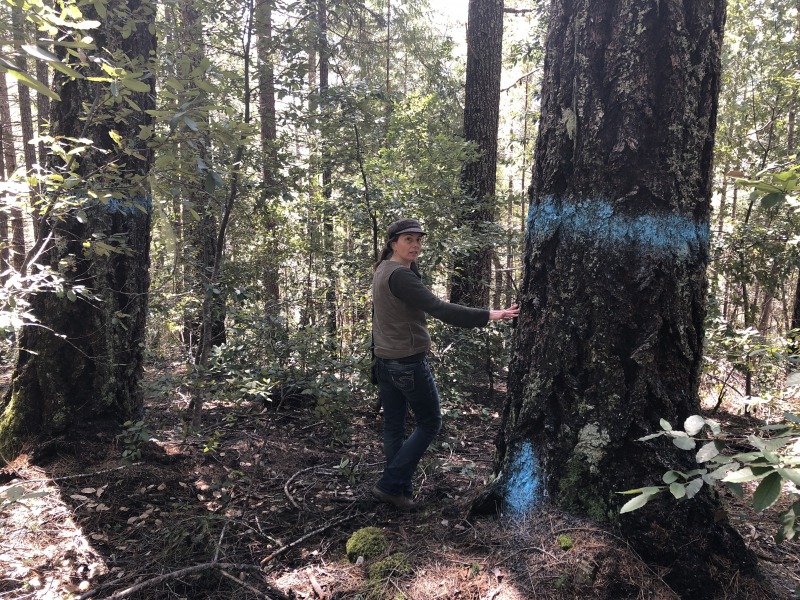
Kimberly Baker in the Klamath National Forest timber sale area [photo by AJ]
In response to criticism by the public, the Mendocino National Forest has drastically scaled back proposed logging in the “Green Flat Restoration Project.” Originally planned for 1,534 acres, the Forest Service has scaled the project back to 250 acres. The agency was criticized for its apparent attempt to characterize logging activities as other more benign actions, such as “reforestation.”
The Green Flat Project was proposed in response to the 2018 Ranch Fire. The project quickly elicited controversy because it appeared that the Mendocino National Forest was attempting to characterize commercial logging under other names to more easily facilitate environmental review of the project. Nearly all federal projects are subject to the National Environmental Policy Act (NEPA), which demands that projects be evaluated to consider potentially significant environmental impacts as well as alternatives and mitigation measures to reduce impacts. A small subset of actions—so-called “categorical exclusions”—are exempt from this longer environmental review process. The Forest Service has defined what types of activities can be pursued under a categorical exclusion. These include post-fire logging of 250 acres or less and “reforestation.”
In January, the Mendocino National Forest announced the proposed project. In a letter soliciting public comment, the Mendocino National Forest first proposed 250 acres of post-fire logging, 1066 acres of “fuels reduction” associated with reforestation, and 218 acres of commercial logging coined as “forest health treatments.” Both fuels reduction and forest health treatments were effectively logging. In its comments on the project, EPIC outlined that this renaming of activities to fit under a categorical exclusion was illegal.
On March 11, the Mendocino National Forest withdrew the proposed project, announcing it would only pursue a smaller 250 acre commercial logging project. Further, the Mendocino indicated that it would reduce the number of living trees logged by taking trees that were estimated to have a 70%+ chance of dying in the future.
“Post-fire forests are ecologically sensitive and respond poorly to intensive logging–that’s why only smaller projects are allowed to utilize a categorical exclusion. Simply renaming logging something else to bypass the rules was clearly illegal and the Forest Service was caught, said Tom Wheeler, Executive Director of EPIC.


Join the discussion! For rules visit: https://kymkemp.com/commenting-rules
Comments system how-to: https://wpdiscuz.com/community/postid/10599/
The enviro nazi’s don’t want anything positive to happen, public entities roll over easily and make it impossible for private landowners to get anything done. There is no compromise with these useful idiots.
Trashman, you took the words right out of my mouth. I agree 100% with you on this issue, and others that the Epic (failure) nut group gets involved in. They are like flies at hunting season. You don’t see them until you harvest an animal and they come by the hundreds! It amazes me how a small group of people can rule with an iron fist.
Subscribe to range magazine for an interesting view of things.
Thanks for the tip, I will look into that. Appreciated.
Funny how the above commenters seem to have missed the global climate catastrophe memo. Too concerned about Obama taking their guns?
Also not paying attention to the deception being practiced by those who tried to call logging “reforestation”. ?????
Another useful idiot.
I did not know that idiots were useful for anything.
Seems Mendo has all too soon forgot about the devastation that this un-managed, un-logged forest created the death toll and life/structure/property loss from The Ranch Fire. This project would be an ideal preventative to this years major fire season that is arising already. They will now be leaving fuels and attended forestland to become prime real estate for a moonscape from a new wildland fire incident this coming year. How many lives and how much acreage of carbon sequestration have to be lost to remind you of our previous years of inferno engulfed neighborhoods, livestock and forest? Funny how nightmares are soon forgotten and given up to allow others to suffer all over again. Good luck stopping the next big one mendo.
You know nothing. This project is a commercial thinning project that would create a healthier, managed, forest that would have paid for itself with the sale of thinned trees. This project is essentially a huge fire break designed to help firefights control a fire in this area from the start and to protect all the rest of the forest around there from burning up in the next big one. EPIC is run by a bunch of idiots who know nothing of forest management and only find lawsuits on trumped-up charges to keep their jobs. They then tell their donors misleading and untrue propaganda to keep the money flowing in. EPIC should either focus on actual impactful projects, like all their donor’s destructive cannabis farms(ya right that will never happen) or be sued out of exsistence. They’re all enviromental nazi clowns.
By the way, that’s a misleading photo — it looks like it is from a completely different project on a different National Forest (Klamath).
In case you haven’t noticed…the rain is slowing to a trickle and the rivers are drying up. The forests have been logged way too hard already. Most “forests” under jurisdiction are actually arid tree plantations, not even native vegetation, and will never reach old growth status. Plant more trees everywhere.
It’s understood that logging aka “timber production” is part of Humboldt’s twentieth century heritage (all of California’s, really) and many families here have solid roots in that means of earning money. However, the belief that there are enough trees to continue reducing the overall canopy without continuing to dry up the state is delusional. Please preserve as much forest as possible (preserving it all is possible) and replant even more.
Freakin 1984 all over again! Reforest, deforest, what’s the dif? I’m off to procure my wall size tv/monitor now. Meh.
Just asking for your local neighborhood to become the next Paradise. Completely idiotic thinking on a very clear subject that is clearly a major catastrophe waiting to happen all over again. You must have missed your local Ranch fire and the death, destruction and chaos that ensued. Manage your forests=protect your damn trees, neighbors, livestock and carbon sequestration.
As you write your comments from the protection of your wooden house sitting on the pot wiping with, wait for it, paper products. Good luck keeping the fire out of town this year.
I hope this is not a duplicate. When I hit my first “submit comment”, the system crashed. Allow me to try again.
I was raised in California. I now live in Pennsylvania, but I think I know the California landscapes pretty well, including those of the Mendocino National Forest. Reading that the “Green Flat Restoration Project” was being reduced by over 80 percent, I was quite discouraged.
When I worked for the United States Forest Service, I helped draft the “National Forest Plan.” It has been 20 years since the report entitled, “Managing the Impacts of Wildfires on Communities and the Environment” [the National Fire Plan] was written by the Departments of Agriculture and Interior. A critical feature of the National Fire Plan was “hazardous fuels reduction improves forest health and its resiliency to fire.” The “Green flat Restoration Project” is an example of the type of work required to help forests become more resilient to disturbances like wildfires. Reducing this project by almost 84 percent is so counter-productive, at least in my view.
In 2001, there was an estimated 38 million acres on our National Forests considered to be at high risk to destructive wildfires. Today, the estimate is about 90 million acres.
In the late 1990s, a General Accounting Office (GAO) report noted that “the most extensive and serious problem related to the health of forests in the interior West is the over-accumulation of vegetation, which has caused an increasing number of large, intense, uncontrollable, and catastrophically destructive wildfires.” Thus, the notion of forest restoration and removing enough hazardous fuels so wildfires are not so catastrophic in their impacts is pretty basic.
There are more trees now than 100 years ago. Forests, which include more than just trees [i.e., the chaparral forests of Southern California], are getting stressed, they are dying, and are becoming a tinderbox for fire. And, once a fire gets a foothold, they become destructive behemoths that destroy everything in their paths.
The facts are, America’s forests are really clogged up. Vegetation needs to be removed on a very large, well-planned scale [for example, high-risk “firesheds”] for a specific purpose. That is, to reduce the scale and intensity of wildfires so eventually, fire can be used as a conservation tool. Accordingly, when we plan for a “Green Flat Restoration Project”, it is really important that we have the courage to follow through and complete the project.
Wildfires and their associated smoke are killers. Aggressive forest management to ensure effective fire management is the key to success. We need to complete as many forest restoration projects as possible to stop what is clearly a national crisis. That is, uncontrollable wildfires.
I hope we do not regret this 84 percent reduction.
“There are more trees now than 100 years ago.”
That’s less than a half truth, sorry, and the fact that you worked for the forest service yet neglect to relate some very important information into your lengthy equation is telling. Much, likely most, of what lay-persons see and consider “forests” are actually supplanted tree farms, and very young, especially compared to what dominated the state 150 years ago. Non-native varieties and development replaced eons-old wetlands, grasslands, etc. The redwoods were almost completely obliterated and there are no more giant oaks. True native forest ecosystems, eons old, were eradicated and replaced for quicker logging turnovers. It’s that simple, and very sad.
This is basic and very pertinent information that the “timber industry” works to suppress. If there were more precipitation, there would be less fire danger. Thick forests and their towering canopies along coastal states generate what we desperately need much more of.
In the very least, you present short term thinking and solutions. In the long run, more native trees need to be planted, and the forests need to be maintained.
Great reply, completely agree, coming from a forestry background as well.
Good reply Mr. Rains. I, like Mr. Rains, worked for the Forest Service for over 30 years, all in California. I am a California professional forester , was an Incident Commander for many years, and headed a Regional/National Incident Management Team for 10 years. I spent most of my career involved in Wildland Fire Management even as a District Ranger on the Big Bear Ranger District on the San Bernadino National Forest and the Smokejumper Base Manager at Redding, CA.
We might not regret this 84% reduction, but someone down the line most likely will. My guess is that at 100% the project was compromised down to less than optimum from an adequate fire resistant productive landscape.
From another perspective I do think the Mendocino Forest Supervisor made a mistake when he/she signed on to stretching the definitions to circumvent the EA process. I understand why they did it, but in the end the effort to propose this under the “categorical exclusion” process was a gamble and failed. I don”t know how they could make a legal defense and either had to go back to the drawing boards or reduce it to the 250 acres. Not what I would consider very scientific , but legal.
In my view, the problem is that the environmentalists have had such a heavy influence on the laws and policies regarding forest management in general and rehabilitation of major burn areas in particular.
I am skeptical of the scientific basis supporting the comment that “Post-fire forests are ecologically sensitive and respond poorly to intensive logging–that’s why only smaller projects are allowed to utilize a categorical exclusion?” Yes, various land management processes have negative as well as positive effects, but how these varying effects are valued is critical. The decision to reduce or deny the removal of merchantable dead trees in a burned over area primarily results in the preparation for the next conflagration. And the revenue from the salvage of merchantable timber provides funds that can be used to do ancillary projects for other resource management activities including treating residual slash and removal of smaller less valuable dead trees (instead of relying on appropriated funds which are usually not available.)
The minimal salvage of merchantable timber has been based primarily on other desirable resource values such as wildlife and water which were not given adequate consideration at one time, but have become the primary consideration over the past 30 years. One example is the Rim Fire that burned over 250,000 acres in the Central Sierra’s (mostly on the Stanislaus National Forest) where only a minimal amount of acres were treated based on wildlife values and natural regeneration. Meanwhile private land was being salvaged and reforested while the government was painstakingly developing EA/EIS.s that the environmental community was participating in and fighting in court. These groups have been so successful in court that many forests don’t even attempt to propose any removal of merchantable timber. I do not propose ignoring these other values, but believe in especially salvaging burned timber should be given more value as a commodity/national resource and a source of funds to manage fuels.
As a result we have hundreds of thousands of acres of snags (dead trees), dead and down fuels, and new growth over the western U.S. One such significant area is in Yellowstone National Park. Under current National Park management direction mechanized activity is severely restricted, but it is a good example as it is well known and beloved. The purists have expounded on the natural regeneration since the early years following the burns in 1988. They are correct in how successful the lodgepole pine along with other herbaceous plants and flowers have regenerated as most professional foresters and technicians working in this timber type predicted. Today, 32 years later (especially in the northwest and northern portion) there are thousands of acres of a combination of snags and dead and down fuels, mixed in with dog-hair thick 30 foot lodgepole pine reproduction. Now all that is needed is weather conditions similar to 1988 and the fire services will be back spending millions of dollars (if not billions) protecting structures worth significantly less. The fuel conditions (especially the snags) will make it very unsafe for firefighters to make any kind of direct attack although the airtanker and fire retardant companies will be ecstatic.
One last question from this forester and ex-Incident Commander, “Why are we so concerned about planting trees in these areas of preplanned conflagrations?
“Preplanned conflagration”??? Are you an arsonist?
Every clear cut since the inception of regulated forestry has been “legal”. Lots of good that’s done, as we’re all experiencing. You also use the label “environmentalists” in a derogatory manner, even suggesting that people who diligently work on their own free time and without compensation to protect our natural world are causing more harm than good.
You, like Mr. Rains, have it well within your powers to lobby for alternatives. If you, as a “professional forester” cannot think of several ways to accomplish large scale native tree planting, then you’re hardly qualified overall. It’s a matter of getting the right people in the right professional positions to dedicate the financial resources to make it happen. As it is, you and Mr. Rains both cite “the market” for wood and byproducts (logging) as a motivating factor in the proposal.
The entire planet desperately needs more thick forests. We can’t make that happen in Brazil or Canada. We can make that happen in California, if we combine our voices and efforts.
Kym Kemp, could you please dedicate a few category tags to this thread? It’s important to be able to reference this issue, and as it is, this article is buried. Thanks for putting the word out!
If you use the Search function at the top rightish of computers and near the bottom of most tablets you can access it at any time. I’ve got limited time and web abilities.
Here it is on a computer.
In the comment, “We Need More Trees, Not Fewer”, I sure agree that our forests along the rural to urban land gradient need to be maintained; indeed better maintained. Why is it, though, that every time the words “forest management” or “forest maintenance” surface, the conclusion is that this means “indiscriminate logging.” And, as former Forest Service Chief Jack Ward Thomas said, “gladiators form and fights ensue”?
Let me be clear, as a registered professional forester, “forest management” does not equate to “indiscriminate logging.” It does mean removing the right amount and types of vegetation from our forests [these include more than just trees] that have become clogged up, so forested landscapes can become more resilient to disturbances [for example, wildfires]. When I say “forest management” or “forest maintenance”, I think of timber harvesting; salvage; hazardous fuel reduction; and prescribed fire when feasible.
I also think of new, innovative biomass uses such as the production of cellulose nanomaterials as additives to concrete [makes it (concrete) about 22 percent stronger] so lower value biomass increases in value. “Forest management” also means developing and expanding markets for wood products so “forest maintenance” can compete economically.
Simply put, comprehensive “forest maintenance” can be a complex enterprise. But no one knows how to do it better than the Forest Service and their state and local partners.
I do know this: if we keep reducing planned restorative projects or not doing them at all, nothing changes and the horrific impacts we have witnessed year after year from large, intense fires will become even greater. Surely that should be reason enough for us to find a more common ground.
Very respectfully,
” Why is it, though, that every time the words “forest management” or “forest maintenance” surface, the conclusion is that this means “indiscriminate logging.” And, as former Forest Service Chief Jack Ward Thomas said, “gladiators form and fights ensue”? ”
That’s simply not true, and suggesting that people who address the real issues are uninformed reactionaries is insulting. There is a concentrated effort to ridicule all “environmentalists” and paint their portraits as being over-reactive and irrelevant. As a professional, you should (and do) know better.
You had the audacity to tell readers there are more trees now than one hundred years ago. What you intentionally neglected to say is that’s because the forests had been logged ad maximum. There are NOT more trees than 200 years ago, and the habitat that existed for literally tens of thousands of years prior had been decimated. You intentionally neglected to say that native habitat has since been supplanted for quick profit motives, and continues to be. It is just as well within your powers to lobby for another direction within the definition of “forest management”…you aren’t addressing uneducated idiots.
One doesn’t have to be a “registered professional” to have a firm understanding of the planet as a balanced aquarium, one that’s been stripped of too much vegetation already. Genuine widespread effort to replant native habitat is critical. We have no jurisdiction over the tundras of the north, or the jungles of the south. We can make a difference here in California, for the world.